




My final dispatch from Locarno is probably the most varied of the quartet that I’ve filed. Fittingly, it’s composed of four films, each from a different section of the festival. Collectively, they’re also the most likely to travel outside of the festival to a screen near you. Most of all, they’re either about defiant people telling their own stories against their oppressors or are works that decry hate and bigotry. They characterize what Locarno Artistic Director Giona A Nazzaro said would be the aim of this festival: “To regain cinema as a freedom that can’t be predicted through algorithms or consumer habits.” These films resist any strict definition.
Florin Șerban’s “You Don’t Belong Here,” the winner of the Golden Leopard, is a classically styled Romanian drama whose methodical rhythm often belies its radical message. It begins unassumingly, maybe even plaintively, with an opening shot of an aged nuclear power plant’s smokestack nestled in a rural field. From there it cuts to an ornate water fountain then to a skate park and then to a sleepy residential neighborhood. This is a small town not unlike many others. But its daytime calm will soon be broken by nighttime hate: We see an army of armored cyclists roll onto a quiet street, slashing car tires, breaking windows, and vandalizing these parked vehicles by placing posters that say “you don’t belong here.” One man, a Romani, tries to defend the neighborhood, only to be savagely beaten to death.
That captivating opening is but a small part of a puzzle whose many pieces will be sequentially added throughout the 254 minutes of Șerban’s interrogative work. By dawn we’re introduced to a new character, Marius Călimanescu (Adrian Văncică), a surgeon who after his morning jog finds his car damaged by that evening’s hooligans. He thinks little of property damage. This single father, whose son Ioan (Teodor Butănescu) is hiding a gnarly leg contusion from an unknown source, is more enamored with keeping his hospital afloat than to worry about what he perceives as outside noise. Unbeknownst to him, the troubles of his town and his son will soon come barreling toward him.
Șerban’s “You Don’t Belong Here” is an intricate picture of misplaced masculinity, toxic discrimination and parental anguish. Its well-earned profundity, reliant on assured compositions and a detailed sound design, pulls one deep into its whirlpool-sized narrative that only seems to gain speed and viciousness as the film progresses. It’s telling, in fact, how much happens underneath Marius’ nose: Ioan visits a clinic for his leg, meets up a mysterious biker guy at the local dam and gives away the yellow bike that Marius bought for him. Instead, Marius is consumed with his reputation. When angry Romani men trash his hospital because the police have decided to autopsy the deceased man who was beaten to death the night before—an order the film suggests is a vindictive bigoted act by Marius’ former high school classmate and current inspector—Marius simply demands the problem be placed outside of his hospital. Worse yet, the only other subject pulling at his attention is his high school reunion where laments he won’t be seen as truly great.
The film smartly closes in on Marius. Cramped compositions between himself and his son show how uncomfortable he is fulfilling his fatherly role, especially as he expresses disappointment that Ioan seemingly has zero ambition. The perpetual presence of police sirens in the soundscape, which increases in volume and in frequency as the film lurches forward further teases reality creeping toward Marius. Văncică’s evolutionary performance, which sees this once confident man reduced to shambles, is another excellent car on a melancholic train barreling toward the heart (his quiet, observational performance does make Șerban’s decision to employ a late on-the-nose voiceover monologue quite disappointing). All these sturdy components combine to patiently render “You Don’t Belong Here” into a soul-shattering picture of grief and regret.
For these dispatches, I’ve tried to primarily focus on films having their world premiere at Locarno. A 2025 Venice Film Festival selection, Nicolas Wadimoff’s “Who Is Still Alive” breaks that trend a bit—especially because it only had a single screening at the Swiss fest. Last week, however, it was announced that Switzerland would be selecting the pro-Palestine documentary as their submission to the 99th Academy Awards, so combined with the imperative subject matter it made even more sense to include some words about Wadimoff’s film.
“Who Is Still Alive” concerns ten subjects: Each hail from Gaza, each escaped to Egypt before the Rafa border was closed on May 7, 2024. They all have a story to tell about survival and loss, with each detail more harrowing than the last. While Wadimoff, who previously directed “Aisheen (Still Alive in Gaza)” in 2010, wanted to film his subjects in Switzerland, the country doesn’t accept Palestinians lacking a visa. He instead opted to shoot on a South African soundstage where Adel Altaweel, a visual artist and one of the subjects, has decided to draw a large map of Gaza in white marker on a black floor. On that map he draws individual boxes that represent where each subject’s home was in Gaza.
Before launching into their respective story, each person shares their intimate memory of what their house and neighborhood looked like, holding back tears as they recall their former, now erased, abodes. Wadimoff mixes these recollections with some unique staging, allowing the camera to track and pan around each subject as they stand upright, bathed in theatrical lighting.
Following these lyrical sequences, the film becomes familiar in form, compiling one-on-one interviews with the figures. All of them have different backgrounds. The defiant Haneen Harara, for instance, is a journalist. A heartbroken Jawdat Khoudary is a businessman. The former mourns the 13 people from her family who died on March 5 in an Israeli airstrike; the latter laments the history and culture permanently lost in the devastating missile strike of Al Mat’haf museum, which he owned. Fascinatingly, in a midway break in the film, Jawdat and Haneen argue over whether they should return to rebuild Gaza. Haneen castigates Jawdat for not being strong enough to take part, demonstrating the magnitude of the hurt Palestinians have endured in war and in exile.
For his part, Wadimoff is attentive to the film’s aching tone. He doesn’t want to make a documentary wholly predicated on trauma. He reaches for ruminative moments like the aforementioned lyrical theatrical sequences and toward the end of the film finds time to get the subjects out of the darkened soundstage to the outside, which is filled with sounds of the wind blowing and children playing. He also leans on the talents of Feras, who, when his family was issued an evacuation order, only took his Qanun with him from his home. That stringed instrument provides a kind of comfort for the end of the film to the subjects and to the viewer for a final bold note that fortifies “Who Is Still Alive” as a story of survival and determination.
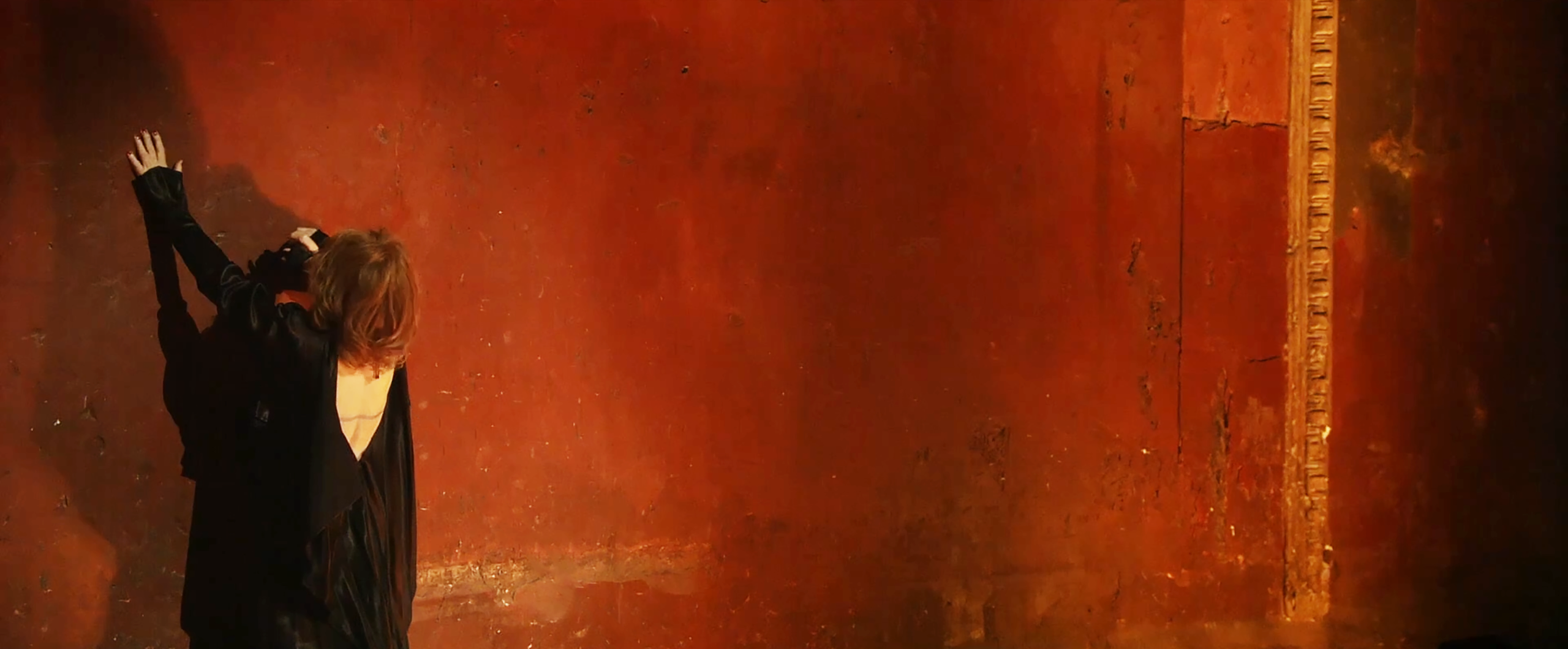
On its face, “Sixteen Moments of My Life,” the latest from Spanish auteur Albert Serra, isn’t terribly notable. Unlike “Pacification” or “Afternoons of Solitude,” idiosyncratic works that embed viewers in insular worlds, his latest film initially appears to be far more conventional. A concert documentary that observes German singer/actress Ingrid Caven’s one-off performance at the Théâtre des Bouffes du Nord in Paris, the film, nevertheless, is just as operatic yet intuitively focused as his prior films.
Caven, who’s best known to cinephiles as a consistent collaborator with Rainer Werner Fassbinder, sings a sixteen song set filled with pieces composed in conjunction with Marc Verdaguer and Joe Robinson. She rarely speaks to the audience, only offering a courteous “merci” every half hour or so; neither Serra nor her ever notify the viewer of each track’s name either. Those details aren’t imperative to them. What counts is allowing space for the overall story to be told without distraction. The result is spellbinding yet stimulating, tangible but fleeting. That’s partly because of the reserve Serra employs in shooting Cavern. He’ll rely on a slow push-in on the opening song for dramatic effect or hold on Verdaguer and Robinson’s accompanying band as they provide kinetic abstract textures to the avant-garde these arrangements for rousing moments of musical alchemy.
And while Cavern remains an island unto herself, situated in the middle of the stage with instrumentalists on either flank, that doesn’t mean she doesn’t work the crowd. Her side door exit off stage, which allows her to steal a few sips of water, leaves the crowd pining for more; her contorted dance with the microphone actualizes the evocative imagery of her songs’ lyrics; her blue satin gown mixed with her mysterious dark sunglasses give a transcendent impression. While performing, Cavern switches between French and German and sings of distant memories and lost loves, bending her voice tightly around these imaginative musical scenes.
Once again, “Sixteen Moments of My Life” isn’t a major work by Serra. But its existence is still major to someone: Cavern. And while this will be more of an oddity for hardcore fans of the director than a necessary example of his filmmaking, it’s a major statement for his subject.
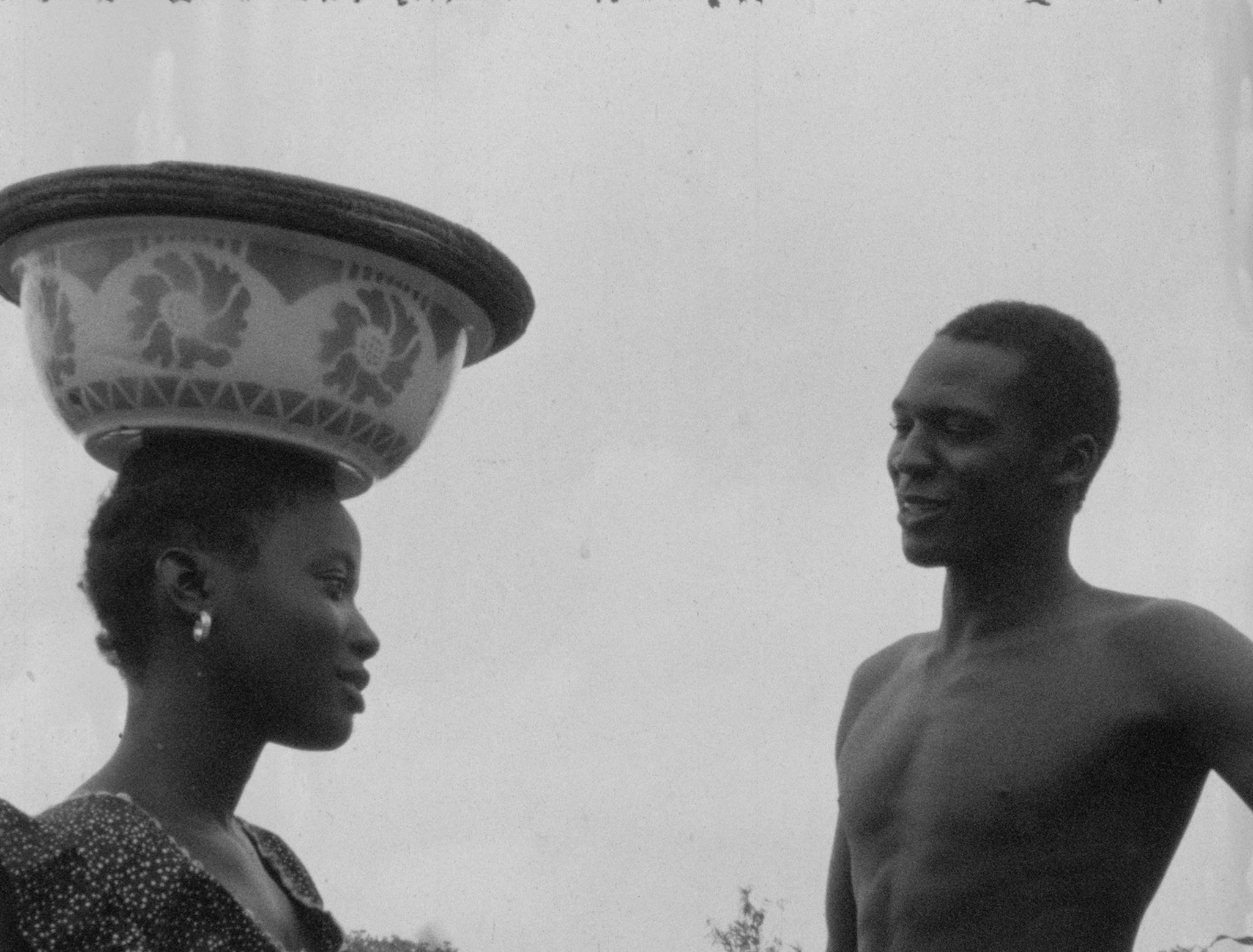
In another change-up, this dispatch isn’t filled entirely of new films. While at Locarno, I saw a restoration of Senegalese auteur Safi Faye’s “Letter from My Village” (“Kaddu Beykat”). The restoration feels notable for a few reasons. For one, Faye’s work is difficult to see because her films aren’t available on streaming (though you can locate them through other means). Also, the 2K revitalization of her classic film, which was carried out by Locarno Heritage in collaboration with Cinegrel from a 16mm master, was touted throughout the festival before most screenings with a brief sizzle reel of the before and after of the restoration. Most importantly, “Letter from My Village” is an integral piece of African cinematic history and a quintessential example of Faye’s interest in the travails of rural Senegalese life.
While the film takes care to record the day-by-day customs and discussions shared in a small African village, it would be a grave mistake to relate it to any ethnographic leanings. Rather Faye crafts a loose narrative about a drought that’s afflicting this small community so badly that it’s revealing the many systematic inequalities engineered against them. We view this oncoming calamity through the eyes of Ngor (Assane Faye), a young man whose aim of marrying Coumba (Maguette Gueye) is momentarily dashed because the drought, which has severely impacted the local groundnut crops, has rendered his family too disadvantaged to afford the necessary cultural accoutrements for the ceremony. To make ends meet, he ventures to Dakar in search of work only to be exploited by those who’ve seen enough people with a similiar plight to know he’s vulnerable and naive.
Accompanying this primary plot, is, of course, the epistolary component—which comes in the form of letters written from a villager to a friend. These letters are read by Faye herself and give voice to the many customs, expectations and roles, particularly between men and women, within this community. These observational words are matched with Faye’s equally expressive lens, which absorbs the many sights of village and urban life—the delineation between the calm pace of the former and bustling force of the latter, especially regarding unnavigable traffic—gives a full picture of the many faces of Senegal. Her winking humor, often displayed in Ngor’s metropolitan troubles, also keeps this work from being a dour affair. By the end, through the monumental achievement that is “Letter from My Village,” one gets a tantalizing sense of Faye as an empathetic filmmaker and a biting storyteller. And hopefully, with a new 2K DCP now readily available, one hopes Faye’s inquisitive picture travels the world once more.