




The moment you hit publish, you become a publisher. That is not a metaphor. It is the legal reality, and it comes with obligations most bloggers never signed up for and a set of protections most bloggers never claim.
I have been running a blog since 2008. In that time I have watched the legal ground shift under bloggers three separate times: once when the EU passed GDPR, once when the FTC rewrote its endorsement rules, and once when generative AI arrived and nobody could say who owned the output. Each shift caught a lot of good people flat-footed.
None of this is legal advice. I am not a lawyer, and you should talk to an actual attorney about your specific situation. What I can tell you is which rules I have had to understand as a working blogger, which ones I teach, and where the guidance you will find elsewhere is out of date. I spend one of the ten curriculum hours in my influencer marketing course at UCLA Extension on FTC disclosure rules alone, and the author of six books on digital marketing in me still finds this the least glamorous and most consequential part of the job.
Search this topic and almost everything on page one is written by a law firm. That is not a knock on those posts. They are accurate. But they are written by people whose business model is you hiring them, so they read like a list of reasons to book a consultation. Most bloggers do not need a lawyer to get started. They need to know which handful of things actually matter, in what order, and what they can do themselves this week.
So that is what this is. A plain-language reference for bloggers, content creators, and small businesses without in-house legal help. Not everything that could theoretically go wrong. The bare minimum you should be worried about, and the point at which each item starts to matter.
Key Takeaways
✅ Copyright protects your posts automatically the moment you write them, but you cannot sue anyone over them until the Copyright Office has actually registered the work.
✅ The Copyright Claims Board is a small-claims venue for copyright disputes that did not exist before 2022, and it is the single most useful enforcement tool most bloggers have never heard of.
✅ Purely AI-generated text and images are not copyrightable in the United States, which means AI-heavy blog content may be sitting in your archive with no protection at all.
✅ FTC disclosure is triggered by any material connection, not just by cash, and since October 2024 the agency can seek civil penalties for review and testimonial violations rather than just issuing warnings.
✅ Section 230 protects you from liability for what commenters write, which is close to the opposite of what most blogging law guides tell you.
What Is the Bare Minimum a Blogger Needs to Do Legally?
Four things cover most bloggers: publish a privacy policy, disclose affiliate and sponsor relationships at the point of recommendation, only publish images and text you own or are licensed to use, and report your blog income. Everything else on this page becomes relevant later, as your traffic, revenue, or risk grows.
The reason so much blogging law advice feels overwhelming is that it presents every obligation at once, with no sense of sequence. In practice these arrive in stages.
| Stage | What to do | Why now |
|---|---|---|
| Day one, before any traffic | Privacy policy, terms and conditions, comment policy | Triggered by collecting any data at all, including analytics and email signups |
| The day you monetize | Affiliate and advertising disclosure, in-content and in the footer | Triggered by the first affiliate link, gifted product, or sponsored post |
| Once the blog earns real money | Separate bank account and bookkeeping; talk to a CPA about entity structure | Determines whether you can deduct expenses against blog income |
| Once you have assets worth defending | Register your best posts with the Copyright Office; consider a trademark on the blog name | Registration is what makes your rights enforceable |
| If you have EU or UK readers | Cookie consent banner with a real decline option | Triggered by non-essential cookies, not by revenue |
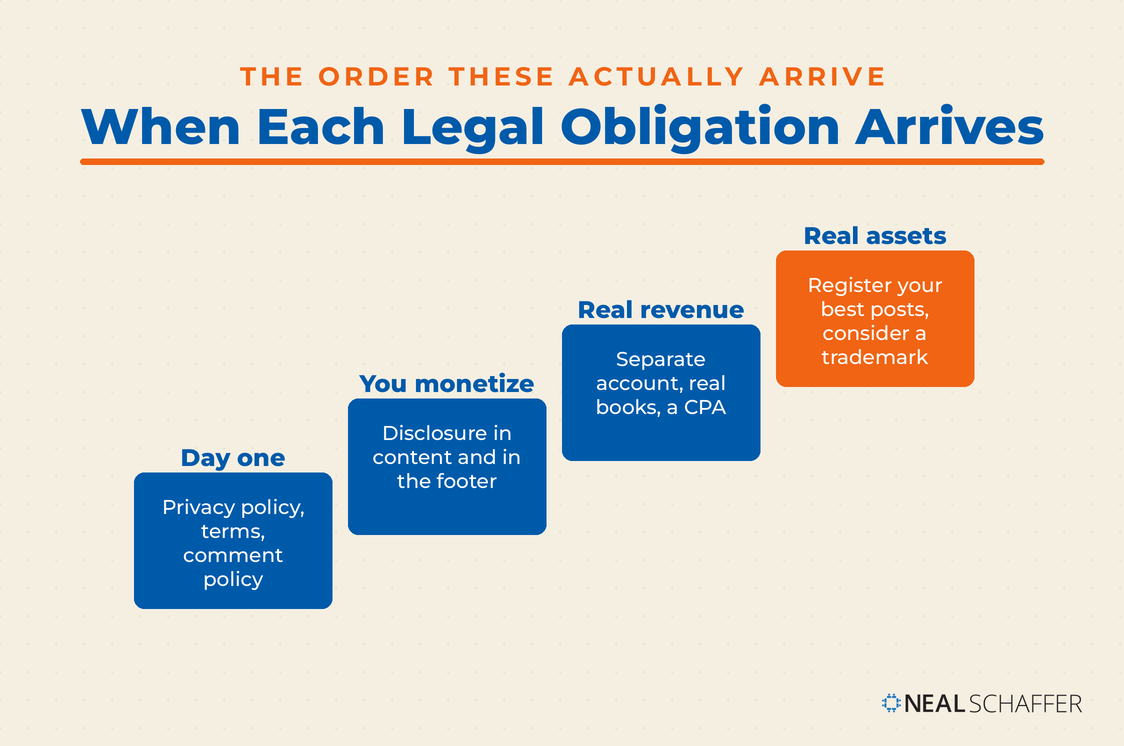
If you do nothing else on this page, do the first two rows. They take an afternoon, they cover the obligations that apply to essentially every blog, and they are the two a reader or a regulator notices first.
### When Do You Actually Need a Lawyer?
Three situations justify the call, and none of them arrive in year one. You get a demand letter, a cease-and-desist, or a takedown notice you did not expect. You are signing a sponsorship, licensing, or partnership contract with terms you cannot read comfortably. Or you are forming an entity, bringing on a partner, or selling the blog.
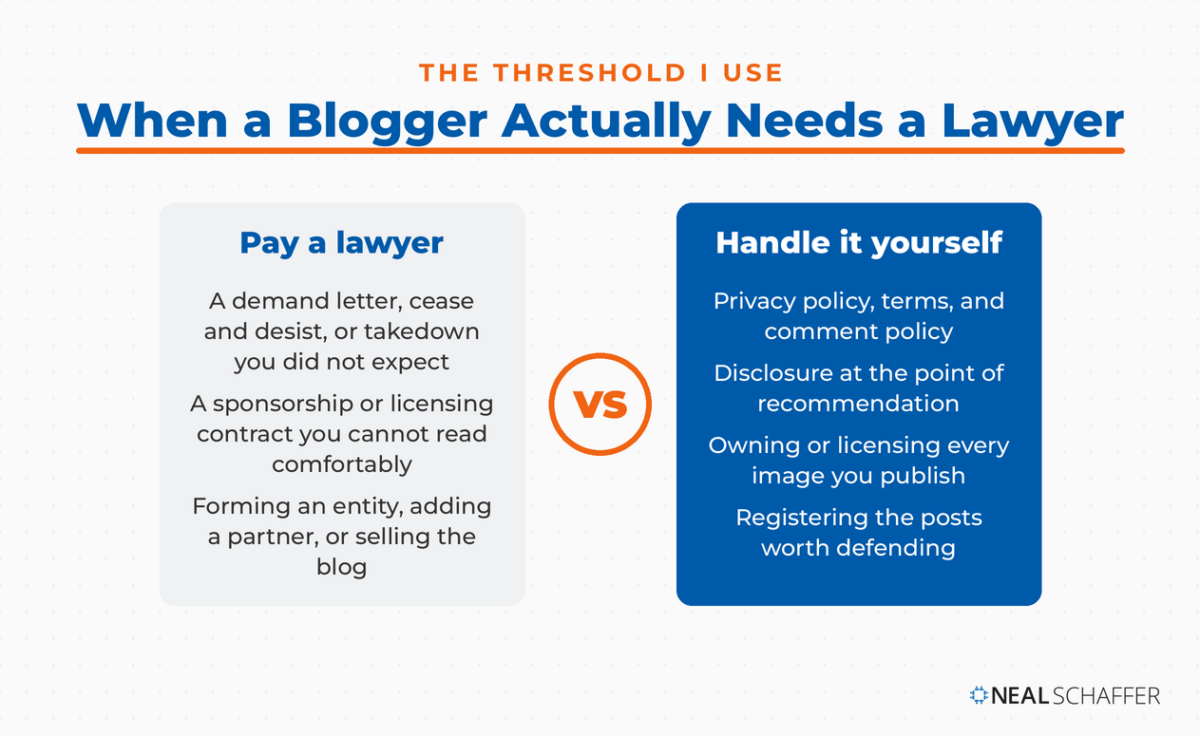
Everything else on this page is work you can do yourself with a template and an afternoon. That is the part the law-firm guides tend to leave out, for an understandable reason. Nobody writes a free article whose conclusion is that you do not need to hire them yet.
The useful mental model is a threshold rather than a checklist. Publish the pages, disclose the relationships, own your images, report the income. When something arrives that has a deadline attached or a signature line at the bottom, that is when you pay someone.
What Laws Actually Apply to a Blog?
Six bodies of law govern almost everything a blogger does: copyright, privacy and data protection, advertising disclosure, defamation, trademark, and tax. Every legal question you are likely to face as a blogger falls into one of those buckets. The rest is contract law, and that only shows up once you start signing sponsorship deals.
Here is how the six break down, and what each one actually asks of you.
| Area of law | What it governs | What you have to do |
|---|---|---|
| Copyright | Your posts, images, and video, plus anyone else’s you use | Own or license everything you publish; register work you want to enforce |
| Privacy and data protection | Emails, analytics, cookies, form submissions | Publish a privacy policy, get consent where required, honor opt-outs |
| Advertising disclosure (FTC) | Affiliate links, sponsorships, gifted products, reviews | Disclose material connections clearly and conspicuously |
| Defamation | Factual claims you make about identifiable people or companies | Verify before publishing; keep your receipts |
| Trademark | Your blog name and logo, plus other people’s brands | Register what you own; avoid implying endorsement you do not have |
| Tax | Income from ads, affiliates, sponsors, products | Report all of it; know whether you are a business or a hobby |
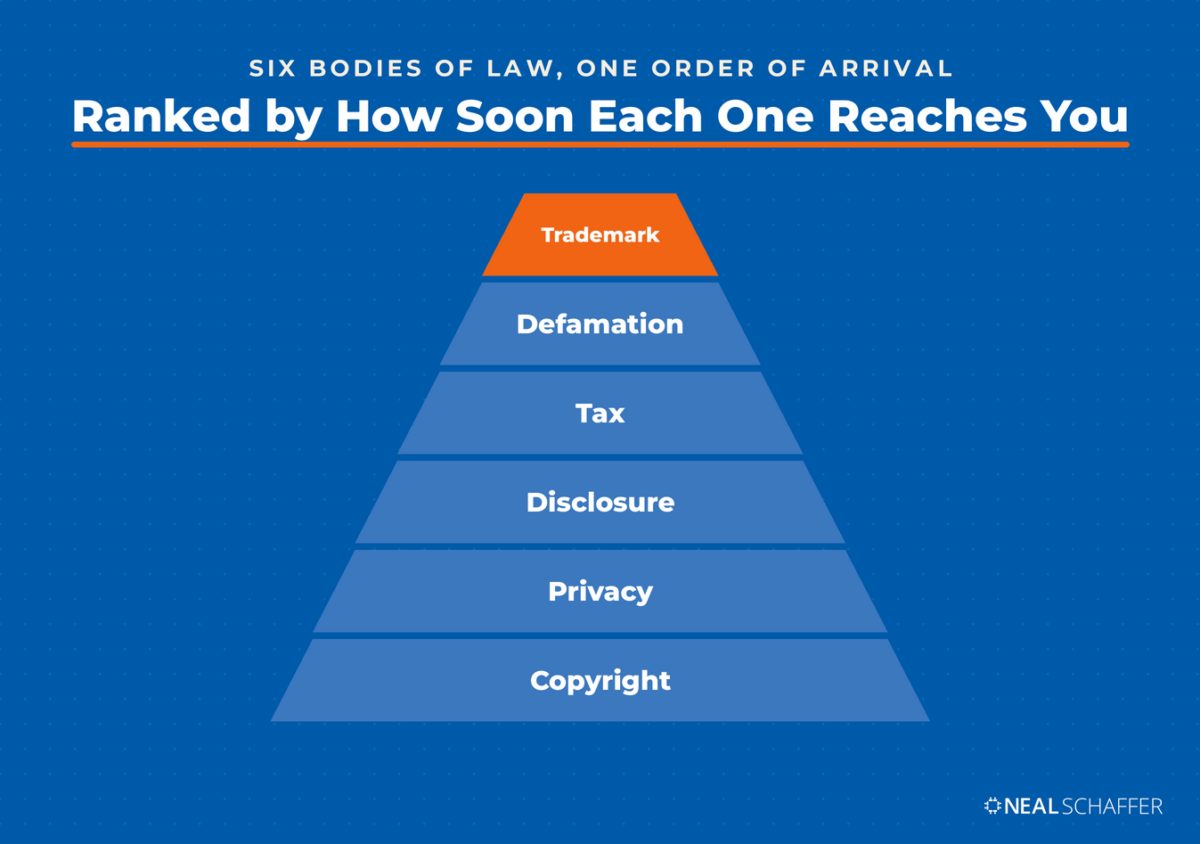
Notice what is not on that list: there is no single “blogging law.” There is no license you need, no registration you must file to publish, and no regulator you report to. The obligations come from general-purpose laws that happen to apply to you because you publish, collect data, and sometimes get paid.
How Does Copyright Law Work for Bloggers?
Copyright protects your blog post automatically. According to the U.S. Copyright Office, a work is under copyright protection the moment it is created and fixed in a tangible form, and registration is voluntary. You do not need a copyright notice, a © symbol, or a filing fee for the protection to exist.
But automatic protection and enforceable protection are two different things, and the gap between them is where most bloggers get hurt.
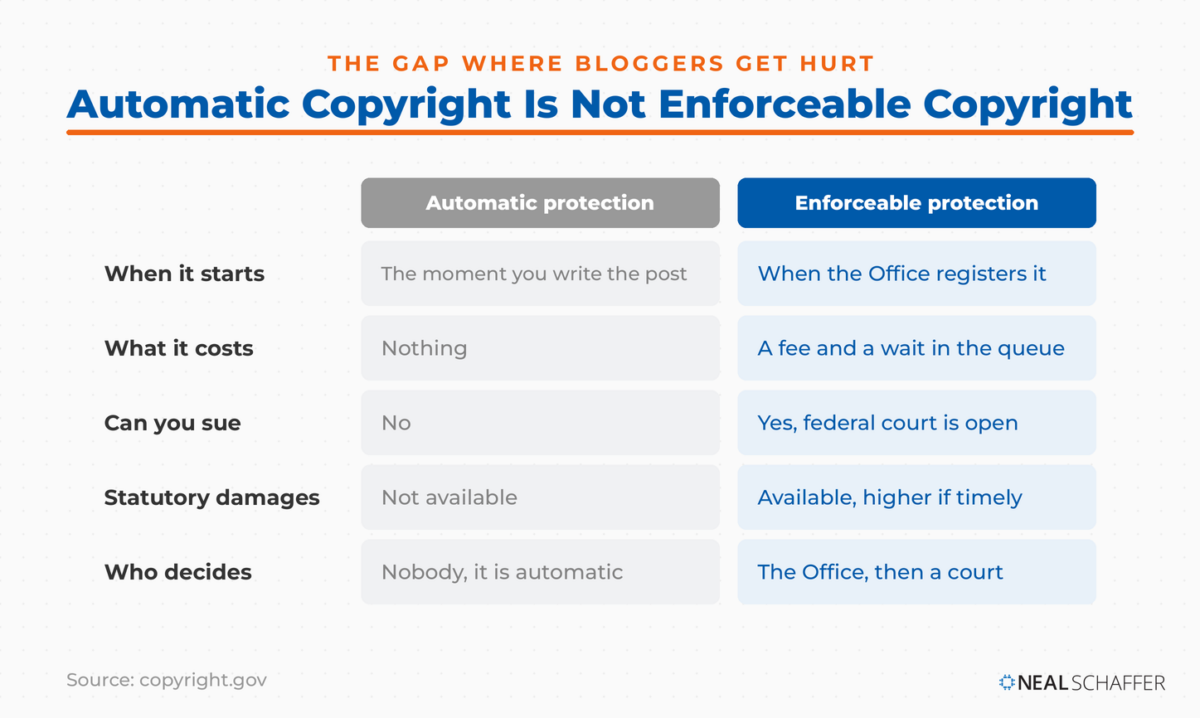
In 2019, the Supreme Court settled the question in Fourth Estate Public Benefit Corp. v. Wall-Street.com, holding that registration occurs, and a copyright claimant may commence an infringement suit, when the Copyright Office registers a copyright. Filing the application is not enough. You have to wait for the Office to act. So if someone lifts your post today and you have never registered it, you are looking at a registration queue before you can do anything in federal court.
That is the practical argument for registering the posts that matter. Not every post. The pillar pieces, the original research, the photography you shot yourself.
### What Is Fair Use, and When Can You Rely On It?
Turn LinkedIn Into a Real Growth Channel
My latest book helps professionals, entrepreneurs, and business owners turn LinkedIn from a static profile into a real source of clients and growth.
Maximizing LinkedIn for Business Growth gives you clear, practical steps to build a profile that gets noticed and a network that actually sends business your way.
Grab your copy on Amazon and put it to work this week. Click the cover or the button below to get started.

Fair use is a defense, not a permission slip. It allows limited use of someone else’s copyrighted work for purposes like criticism, commentary, news reporting, teaching, and research, and courts weigh four factors to decide whether a specific use qualifies. It is decided case by case, after the fact, by a judge.
That last part is what bloggers underestimate. “It’s fair use” is not something you get to declare. It is something you argue, in a proceeding you are already in.
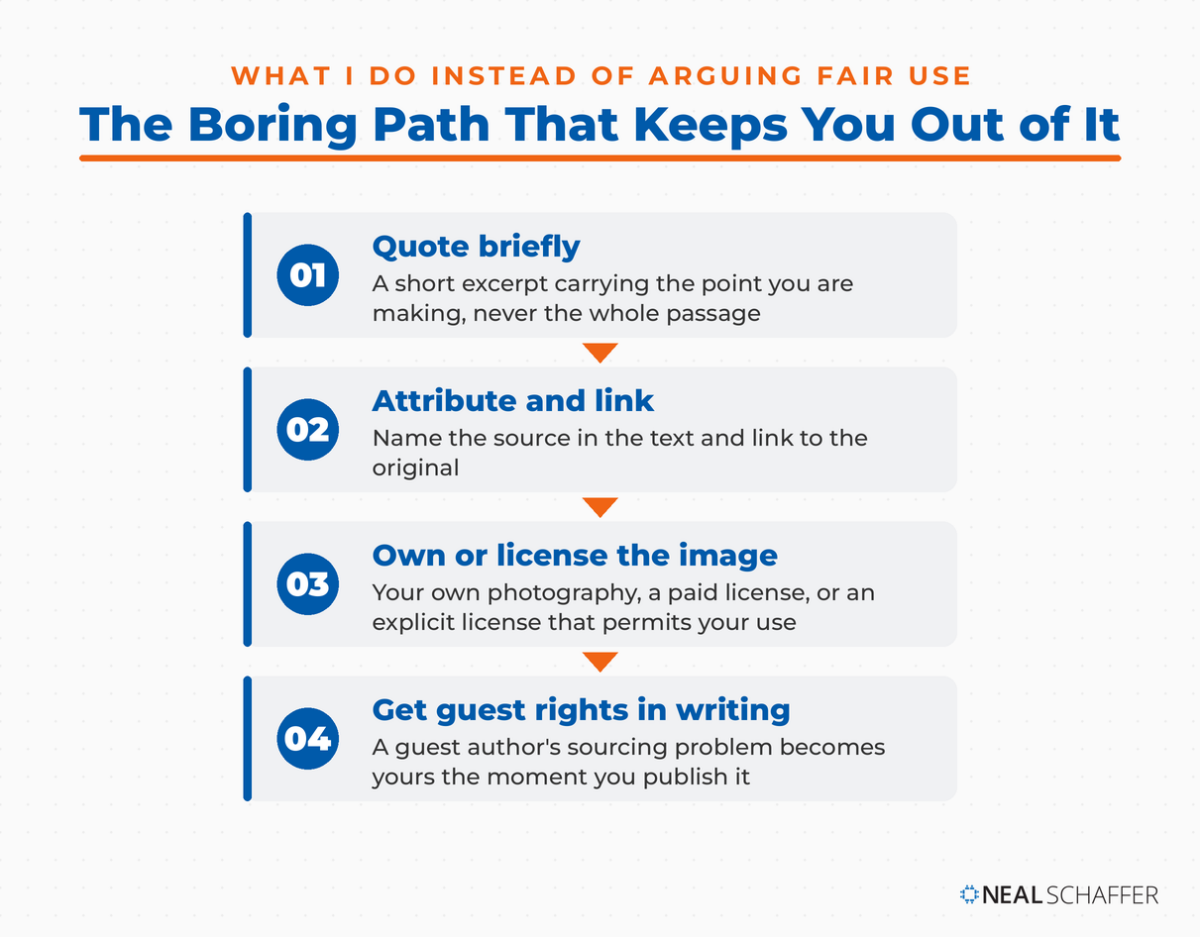
For everyday blogging, the safe path is boring and it works. Quote briefly and attribute clearly, with a link to the original. Use images you created, licensed, or that carry an explicit license permitting your use. If you want to make your own work reusable on defined terms, license it under Creative Commons and pick the license that matches how much reuse you actually want.
Guest content deserves its own note here. When you accept a guest post, you are publishing someone else’s work under your name and on your domain, which means their sourcing problems become your sourcing problems. If you run guest blogging on your site, get the rights in writing and check the images.
### What Happens If Someone Steals Your Blog Content?
You have three escalating options: a direct request, a DMCA takedown notice to the host or platform, and a formal claim. The third option changed in 2022 with the creation of the Copyright Claims Board, a small-claims tribunal inside the Copyright Office designed for exactly the kind of dispute a blogger has.
This is the part almost no blogging law guide covers, and it is the part that matters most.
Federal copyright litigation is out of reach for a working blogger. The Copyright Claims Board caps monetary damages at $30,000 and notes that in federal court, by contrast, actual damages are not capped and statutory damages can reach $150,000 for each work if the infringement was knowing or deliberate. The CCB trade-off is a lower ceiling in exchange for a venue you can actually use, online, without an attorney.
| Federal court | Copyright Claims Board | |
|---|---|---|
| Damages ceiling | Uncapped actual damages; statutory damages up to $150,000 per work for willful infringement | $30,000 total per proceeding |
| Attorney required | Effectively yes | No |
| Respondent can refuse | No | Yes, respondents may opt out |
| Registration | Required before filing | Required, but claims may be filed while an application is pending |
Two catches worth knowing before you plan around it. The respondent can opt out, which sends you back to federal court or nowhere. And timing still matters: the CCB’s own claimant guidance explains that statutory damages are capped at $15,000 per work when the work was registered within the timeframe set by section 412 of the Copyright Act, and at $7,500 per work when it was not.
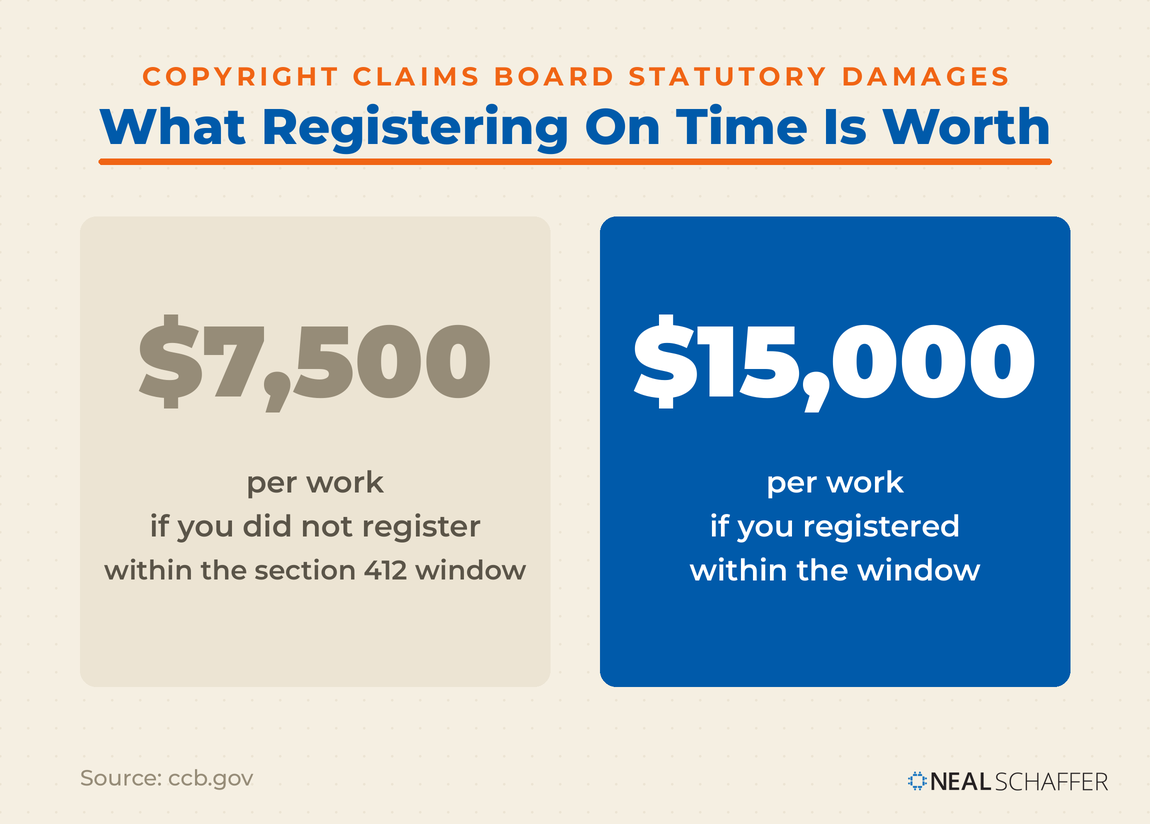
Register early, and you have a real remedy. Register late, and you have half of one.
### Is AI-Generated Blog Content Copyrightable?
No, not the parts a machine wrote on its own. In January 2025 the Copyright Office published Copyright and Artificial Intelligence, Part 2: Copyrightability, concluding that copyright does not extend to purely AI-generated material, that whether human contributions are sufficient must be analyzed case by case, and that based on current technology, prompts alone do not provide sufficient control.
Sit with that for a second, because the implication is bigger than it looks. If you have been publishing AI-drafted posts with light edits, the AI-generated expression in them is not protected. Someone can copy it. You cannot stop them.
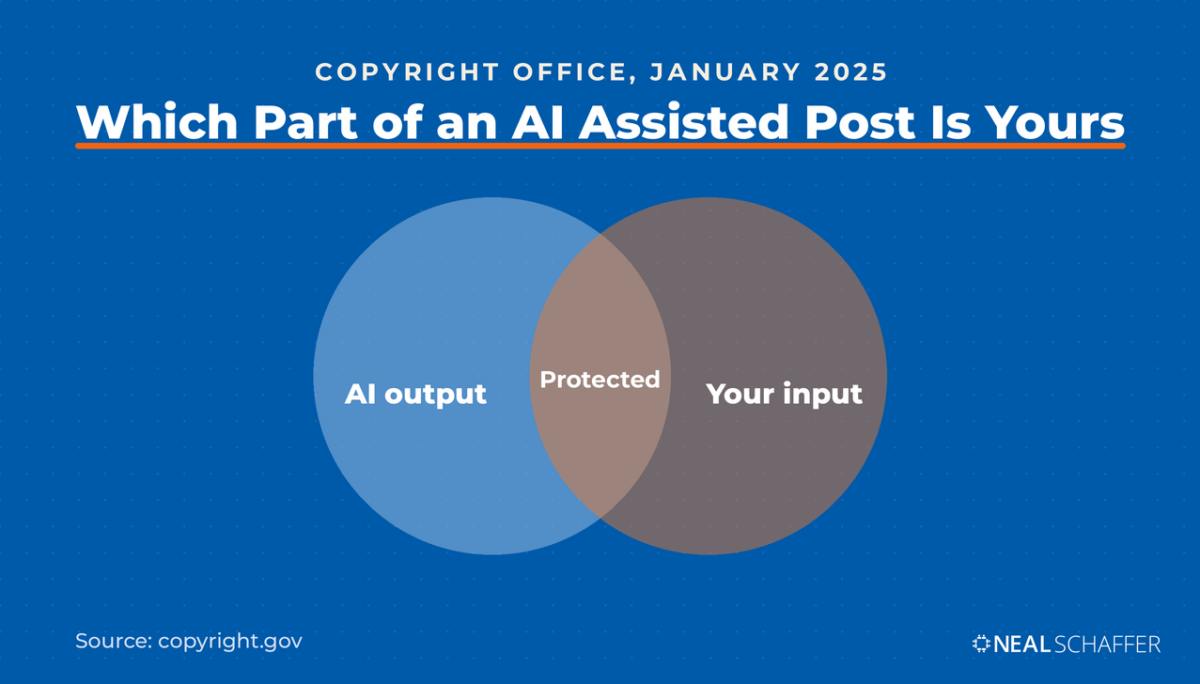
The Office was clear that human authorship perceptible in the output is still protected, as is creative selection, arrangement, and modification of AI output. That is not a loophole; it is a description of how you should be working anyway. The way I use AI in AI blogging is as a research and drafting assistant on work I structure, rewrite, and stand behind, which is also the version that survives a copyrightability analysis.
What Privacy Laws Do Bloggers Have to Follow?
If your blog collects email addresses, runs analytics, or serves cookies, privacy law applies to you. Three regimes reach ordinary bloggers: the EU’s GDPR, California’s CCPA as amended by the CPRA, and the patchwork of other U.S. state privacy laws. All three want the same thing. Tell people what you collect, why, and how to opt out.
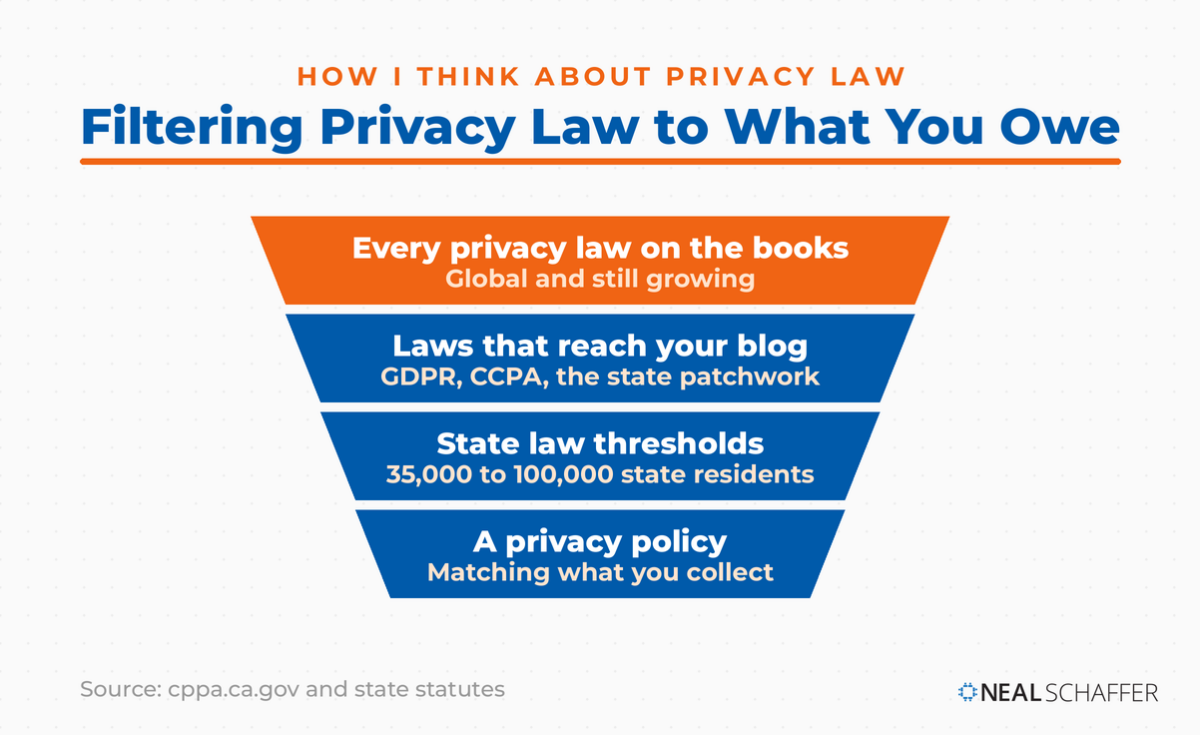
The GDPR is the one with teeth. Under Article 83, the most serious infringements carry administrative fines of up to 20 million euros, or in the case of an undertaking, up to 4% of total worldwide annual turnover from the preceding financial year, whichever is higher. No individual blogger is getting a 20 million euro fine. But under Article 3, the GDPR reaches controllers outside the EU where the processing relates to offering goods or services to, or monitoring the behaviour of, people in the EU. Where you sit is not the test.
California is where enforcement has gotten concrete. The California Privacy Protection Agency has issued decisions requiring clothing retailer Todd Snyder to change its practices and pay a $345,178 fine, and American Honda Motor Co. to pay $632,500, which the agency called one of the highest fines in the law’s history. Under the CCPA, California residents have the right to know what is collected, to delete it, to opt out of its sale, to correct inaccuracies, and to limit use of sensitive personal information.
And the patchwork keeps growing. The IAPP reports 19 enacted statewide consumer privacy laws, with Indiana, Kentucky and Rhode Island coming online on January 1, 2026.
Most of these laws have thresholds that a small blog will not cross. That is genuinely reassuring, and I am not going to pretend otherwise. But the privacy policy requirement is the piece that applies to essentially everyone, because it is triggered by collecting personal information at all rather than by revenue or volume. If you are actively promoting your blog and building a list, you have a privacy policy obligation.
### What About Cookie Consent?
Cookie consent is required where you serve users under laws that treat cookie data as personal data, most notably in the EU and UK. In practice that means a banner that discloses cookie use before non-essential cookies fire, and gives readers a real way to decline. Analytics and advertising cookies are the ones that count.
For a blog with international traffic, the pragmatic answer is to configure for the strictest regime you touch and stop maintaining separate logic per region. It is cheaper than the alternative and it ages better.
What Are the FTC Disclosure Rules for Bloggers?
The FTC requires you to disclose any material connection between you and a product you endorse, clearly and conspicuously, in the place a reader meets the endorsement. A material connection is any financial, employment, personal, or family relationship, including free product. The agency’s Disclosures 101 for Social Media Influencers is the plain-language version.
“Material” is the word that trips people up. It does not mean cash.
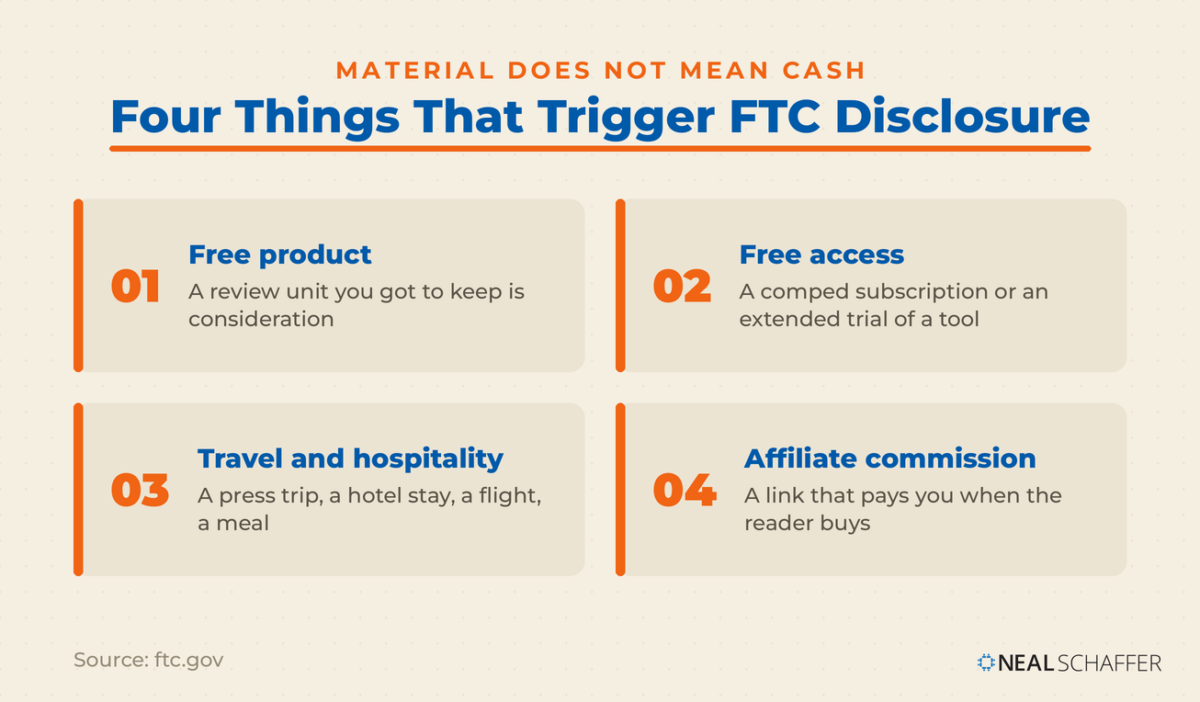
Bobby Robinson, an intellectual property attorney who practices as The Influencer Attorney, told me on my podcast that the free-product assumption is exactly where creators go wrong: “Most folks think, well, I didn’t get paid for the engagement, so I don’t have to disclose it. Well, that’s not true. There was some form of consideration, whether it was a free hotel stay or a flight or a meal or something of that nature.”
A free trial of a tool is consideration. A press trip is consideration. A review unit you got to keep is consideration.
And the pressure to skip the disclosure is real. Companies still come to me saying they want to work together but would rather I not mention that it was sponsored. The answer is always no, because that is not a style preference, it is the law. If a brand asks you to hide the relationship, that tells you something useful about the brand.
I will tell you how I handle it, because I think the standard should be visible rather than theoretical. In *Digital Threads* I put the disclosure in the front matter, in plain language: for many of the tools I talk about in the book, I am also an affiliate or have been gifted access to their technology, and nobody paid me to mention them. Same principle on the blog. If there is a relationship, it gets stated where the reader meets the recommendation, not buried in a footer.
### What Changed With the FTC’s 2024 Reviews Rule?
The Endorsement Guides have always been guidance rather than independently enforceable rules, which limited what the FTC could do about violations. That changed. The Commission’s Rule on the Use of Consumer Reviews and Testimonials went into effect on October 21, 2024, and the FTC states that the rule authorizes courts to impose civil penalties for knowing violations.
For bloggers, three provisions matter. Fake or false consumer reviews and testimonials are prohibited, including ones from people who never actually used the product. Paying or offering incentives for reviews that express a particular sentiment, positive or negative, is prohibited. And reviews written by company insiders have to disclose that relationship clearly and conspicuously.
If you run product roundups or maintain a review section, that is a compliance surface you did not have four years ago. The same applies if you are pursuing blogging and affiliate marketing at any scale, since affiliate content is advertising and always has been.
Generally, no. Section 230 of the Communications Act shields you from being treated as the publisher of content someone else wrote on your site. This is the single most misunderstood point in blogging law, and a lot of guides get it backwards by telling bloggers they are responsible for everything that appears on their domain.
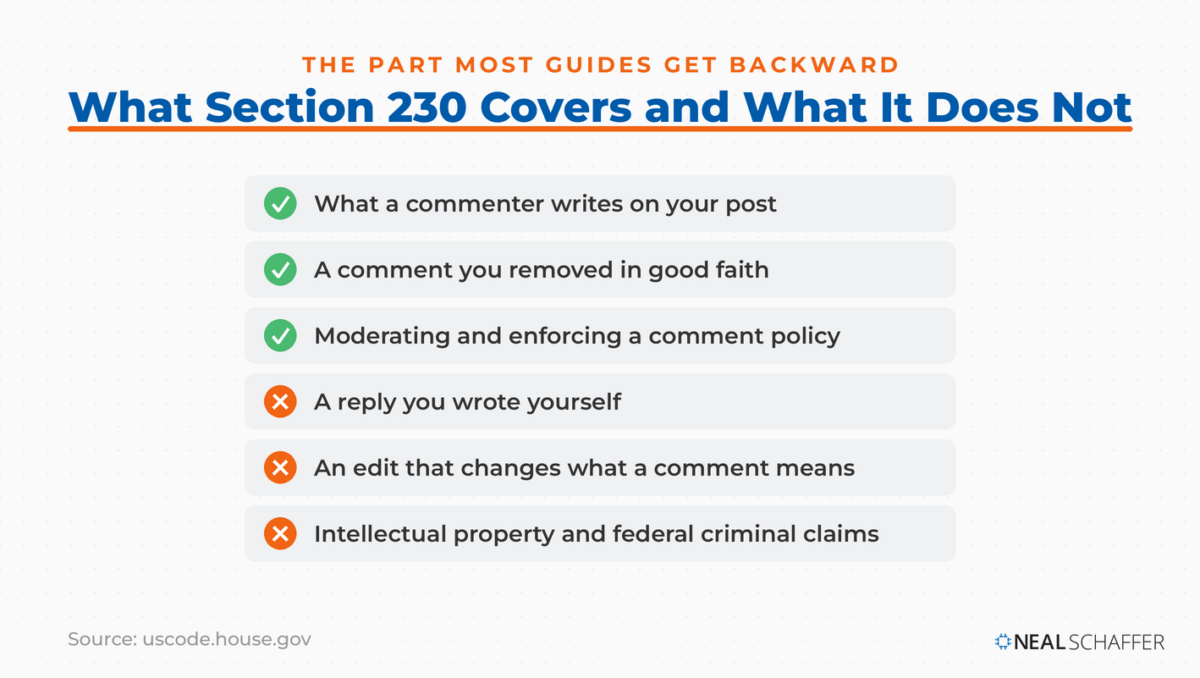
The statute is short and blunt. 47 U.S.C. 230(c)(1) says that no provider or user of an interactive computer service shall be treated as the publisher or speaker of any information provided by another information content provider. Subsection (c)(2) adds that they cannot be held liable for voluntarily restricting access to objectionable material in good faith.
Read the second half of that again, because it is the part that gets lost. Moderating does not forfeit your protection. The good-faith removal provision exists precisely so that operators can clean up their comment sections without becoming publishers of what remains.
The immunity has limits. It does not cover content you created or materially developed yourself, and it does not cover intellectual property claims, federal criminal law, or certain other carve-outs. If you edit a commenter’s remark in a way that changes its meaning, or write the defamatory line yourself in a reply, that is your content and Section 230 does not help you.
For the free-speech side of this, the Electronic Frontier Foundation’s Legal Guide for Bloggers is the best free resource I know of. Bookmark it before you need it.
Practically: publish a comment policy, moderate in good faith, and remove what does not belong. Not because the law forces you to, but because the alternative is a comment section nobody wants to read.
How Do Defamation and Trademark Rules Affect Bloggers?
Defamation is a false statement of fact that damages someone’s reputation; in writing, it is libel. Opinion is not defamation, and truth is a complete defense, which means your exposure comes almost entirely from stating things as fact that you cannot back up. Trademark is a separate problem: it governs names and logos rather than content.
Most bloggers will never face a defamation claim, and the ones who do usually got there the same way. They made a specific factual assertion about an identifiable person or company, in the heat of writing, without a source they could point to. “This company scammed me” is a factual claim. “I would not work with this company again, and here is what happened” is a description of your experience.
Verify before you publish. Keep the receipts. Link to the evidence.
On trademark, two directions. Protecting your own: you can register a trademark with the USPTO to protect your blog name, logo, or tagline, which is worth doing once your blog has commercial value. Respecting others’: naming a brand to talk about it is fine, and always has been. What you cannot do is use someone’s mark in a way that suggests they endorse or are affiliated with you. The Nike swoosh in your header implies a relationship you do not have.
What Do Most Blogging Law Guides Get Wrong?
Four things, consistently. Most are written by law firms, so they list every obligation at once with no sense of what to do first. They treat comment liability backwards. They stop at “get a privacy policy” without saying what triggers it. And they predate the two developments that actually changed things for bloggers: the Copyright Claims Board and AI copyrightability.
The law-firm problem is the biggest one, and it is structural rather than dishonest. If your business is legal services, the natural way to write about blogging law is to catalog everything that could go wrong. That is genuinely useful if you are already in trouble. It is close to useless if you are a solo blogger trying to work out what to do on a Tuesday afternoon with no budget.
There is a fifth, and this one is my own bias showing. Almost every guide frames blogging law defensively, as a list of ways to avoid getting sued. That framing is why so many bloggers ignore the whole topic. It reads like homework with no upside.
The upside is real, though. Registration is what converts your archive from something you feel bad about when it gets scraped into something you can act on. Trademark registration protects a name you have spent years building. A clean disclosure practice is a trust signal that survives every algorithm update, and given how much AI now sits between your blog and your reader, being the source that is transparently sourced is not a small thing.
My own mistake was waiting. I ran this blog for years before I thought seriously about any of it, and the honest reason is that the legal side felt like a tax on the fun part. It is not. It is the part that makes the asset an asset.
What Are the Tax Rules When Your Blog Makes Money?
All blog income is reportable, whether or not you get a 1099 and whether or not you consider the blog a business. The distinction that actually matters is business versus hobby, because it determines whether you can deduct expenses against that income.
The IRS states that in making the distinction between a hobby or business activity, you take into account all facts and circumstances, that a hobby activity is an activity not done for profit, and that no one factor alone is decisive. The factors include whether you carry on the activity in a businesslike manner with complete and accurate books and records, and whether you have personal motives in carrying it on.
In practice, the businesslike-manner factor is the one you control. Separate bank account. Real bookkeeping. A written plan. Tracked expenses. Bloggers who lose this argument usually lose it on records, not on intent.
Two other things worth raising with a CPA rather than a blog post. Whether an LLC makes sense for you, which is a liability question as much as a tax one. And sales tax, if you sell digital products directly. Both of those get expensive to fix retroactively, and both are cheap to set up correctly at the start. If you are serious about how to make money blogging, have the conversation before the revenue arrives rather than after.
Which Legal Pages Does Your Blog Actually Need?
Four pages cover almost every blogger: a privacy policy, an affiliate and advertising disclosure, terms and conditions, and a comment policy. A cookie notice is a fifth if you serve EU or UK readers, and it is often bundled with the privacy policy.
| Page | Triggered by | Where it lives |
|---|---|---|
| Privacy policy | Collecting any personal data, including analytics and email signups | Footer, linked sitewide |
| Affiliate and advertising disclosure | Affiliate links, sponsorships, gifted products | Footer plus in-content, at the point of recommendation |
| Terms and conditions | Publishing at all; sets the rules between you and readers | Footer |
| Comment policy | Allowing comments | Footer or above the comment form |
| Cookie notice and consent | Non-essential cookies with EU or UK readers | Banner on first visit, plus a preferences link |
Two implementation notes. The in-content half of the disclosure requirement is the one bloggers skip, and it is the one the FTC cares about, because a footer link is not “clearly and conspicuous” at the point of the endorsement. And these pages are not decoration: they should describe what you actually do. A privacy policy that promises you never share data while your analytics say otherwise is worse than no policy, because now the inaccuracy is documented in your own words.
If you are still setting up and working through blogging tips or thinking about how to monetize a blog, build these pages before the traffic arrives. It takes an afternoon at the start and a lawyer later.
Frequently Asked Questions About Blogging Laws
Not for protection, which is automatic. You do need registration to file an infringement suit, and timely registration raises the damages available to you. Register the posts with real commercial value rather than everything you publish.
Yes, if you collect personal data, and running analytics or an email signup form counts. The privacy policy obligation is triggered by data collection, not by revenue.
Not for honest opinion based on your actual experience. Trouble comes from stating unverifiable things as fact, and from failing to disclose if you received the product free or have an affiliate relationship with a competitor.
Partly. Copyright is broadly harmonized through international treaty, and GDPR follows your readers rather than your address. Disclosure, defamation, and tax rules vary significantly by country, so treat the U.S. specifics here as a model rather than a universal answer.
It is a starting point, not an endpoint. A template you edit to match what your site genuinely does is fine for most blogs. A template you paste unread is a written record of promises you are not keeping.
Get the Legal Foundation Right Before You Scale
Go back to the staging table near the top and do the first two rows this week. Privacy policy, terms, comment policy, then disclosure at the point of recommendation. That is the bare minimum, it takes an afternoon, and it puts you ahead of most blogs your size.
Set a calendar reminder to revisit the list once a year. Everything else on this page arrives when the blog is ready for it, and none of it needs a lawyer on day one. As traffic grows, so does exposure, which is a good problem and worth planning for rather than reacting to. If you want to see what that growth curve looks like in aggregate, the current business blogging statistics are a useful reality check, and if you are earlier in the journey, start with how to start a blog and build the legal pages in from day one.
And if you want help connecting your blog to the rest of your marketing rather than running it as an island, download a free preview of Digital Threads or talk to me about Fractional CMO services.
Actionable advice for your digital / content / influencer / social media marketing.
Join 13,000+ smart professionals who subscribe to my regular updates.