




The head of the World Health Organization said Friday that the Ebola outbreak centered in the Democratic Republic of Congo is “spreading rapidly” and now poses a “very high” risk at the national level.
WHO Director-General Tedros Adhanom Ghebreyesus said the United Nations health agency had raised its alert over the risks of the outbreak spreading within Congo, but that it remained lower outside the county.
“The Ebola outbreak in the Democratic Republic of the Congo is spreading rapidly,” Ghebreyesus said. “We are now revising our risk assessment to very high at the national level.”
The risk of spread remains high within the region, and low at global levels, he told reporters.
Seros Muyisa / Gerry Images
The WHO chief said 82 cases had been confirmed in Congo, with seven confirmed deaths, “but we know the epidemic in DRC is much larger,” with almost 750 suspected cases and 177 suspected deaths from the virus.
The situation in neighboring Uganda is “stable,” he said, with two cases confirmed in people who had visited Congo, and one death.
On Thursday, people set fire to an Ebola treatment center in a town at the heart of the outbreak in eastern Congo after being stopped from retrieving the body of a local man, a witness and a senior police officer told The Associated Press, as fear and anger grow over a health crisis that doctors are struggling to contain.
The arson attack in Rwampara reflected the challenges health workers face as they try to curb the rare Ebola virus behind the current outbreak with stringent measures that can clash with local customs, including burial rites. The disease has been spreading for weeks in a region lacking in adequate health facilities, and where many people are on the move to escape armed conflicts.
The bodies of those who die from Ebola can be highly contagious and lead to further spread if people prepare them for burial and gather for funerals. The dangerous work of burying suspected victims is being managed wherever possible by authorities, which can be met by protests from victims’ families and friends.
The center in Rwampara was burned by local youths who became angry while trying to retrieve the body of a friend who had apparently died of Ebola, according to a witness who spoke to the AP by telephone.
“The police intervened to try to calm the situation, but unfortunately they were unsuccessful,” said Alexis Burata, a local student who said he was in the area. “The young people ended up setting fire to the center. That’s the situation.”
The Reuters news agency captured images of the treatment center burning.
Gradel Muyisa Mumbere/REUTERS 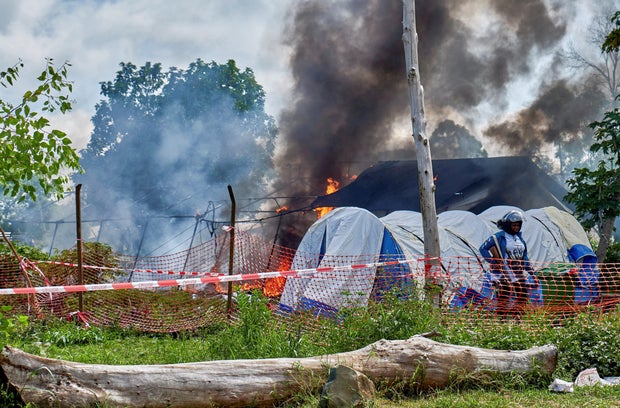
An AP journalist saw people break into the center and set fire to objects inside and also to what appeared to be the body of at least one suspected Ebola victim that was being stored there. Aid workers fled the treatment center in vehicles.
Deputy Senior Commissioner Jean Claude Mukendi, head of the public security department in Ituri Province, said the youths had not understood the protocols for burying a suspected Ebola victim.
“His family, friends, and other young people wanted to take his body home for a funeral even though the instructions from the authorities during this Ebola virus outbreak are clear,” Mukendi said. “All bodies must be buried according to the regulations.”
Hama Amadou, field coordinator for the humanitarian organization ALIMA, which had teams working at the center, said later that calm had been restored and that aid teams were continuing their work at the center.
The flash of anger underlined the complications faced by both Congolese authorities and an array of aid agencies trying to stem an outbreak that the WHO declared a public health emergency of international concern early this week.
“We are still in the phase where we are intensifying the investigation, searching for cases,” said Jean Kaseya, Director-General of the Africa Centers for Disease Control and Prevention. “I expect the number of cases to increase as surveillance becomes more and more rigorous.”
Michel Lunanga/Getty 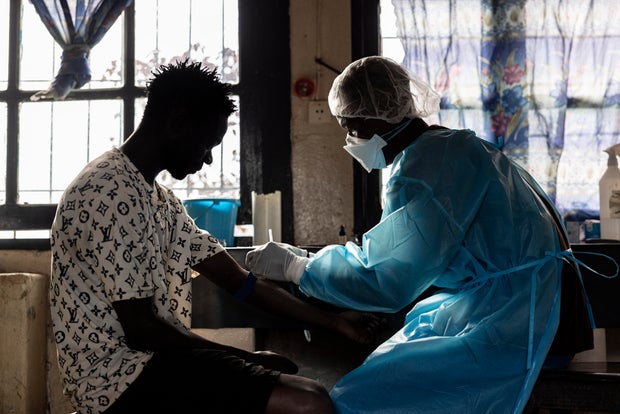
Early detection of the virus is key in saving lives, but the region’s already weak health infrastructure and surveillance capacity has been further weakened by international aid cuts, experts say. There are over 920,000 internally displaced people in Ituri Province, according to the U.N.
Armed conflict in the region further complicates efforts to handle the crisis. Local leaders said an attack by ISIS-linked militants killed at least 17 people on Tuesday in Alima, a village in Ituri.
Up to nine-month wait for vaccine
Health workers and aid groups have said they are in dire need of more supplies and staff to respond. Also, there is no available vaccine or medicine for the Bundibugyo strain responsible for the outbreak.
An expert said this week it would be at least six to nine months before one would be available.
“The priority now is to act quickly and work closely with communities, as the coming days are critical,” said Ariel Kestens, the head of the International Federation of Red Cross and Red Crescent Societies delegation in Congo.
Ebola is highly contagious and spreads in people through contact with bodily fluids such as vomit, blood, feces or semen. Symptoms include fever, vomiting, diarrhea, muscle pain and at times internal and external bleeding.
The virus spread undetected for weeks following the first known death in late April as Congolese health authorities tested for a different Ebola virus more commonly responsible for outbreaks in the country. Health officials have not yet found “patient zero,” according to the WHO.
The scale of the outbreak so far suggests it “started probably a couple of months ago,” said Anaïs Legand, a viral hemorrhagic fevers expert at the WHO.
The U.S. government has placed restrictions on any travelers who have visited Congo, Uganda or South Sudan in the previous 21 days, barring foreign visitors among them from entering the U.S. and requiring U.S. citizens and permanent residents to be diverted to Washington Dulles International Airport for screening.
India and the African Union said Thursday that the India-Africa Forum Summit, scheduled to be held next week in New Delhi, had been postponed due to the “evolving health situation in parts of Africa.”
On Wednesday, Congo’s soccer team canceled a three-day World Cup preparation training camp and a planned farewell to fans in the capital Kinshasa because of the Ebola outbreak.