




Venus’ bizarre and extraordinarily slow retrograde rotation on its axis has long puzzled planetary scientists. But in a new paper presented at the recent European Geosciences Union General Assembly in Vienna, the authors argue that their models indicate that a high angle moon-sized, high-velocity impactor likely triggered Venus’s strange 248-day rotation. And it probably happened within the first 50 million years of Venus’ formation.
We wanted to explore the possibility that an impact would have modified the rotation of the planet, Cedric Gillmann, the paper’s lead author and a planetary scientist at ETH Zurich, told me in Vienna. But it would have had to have been a high angle impactor if it modified the rotation of the planet’s initial rotation significantly, he says.
Today, our twin planet Venus, which is almost the same size as Earth has 467-degree Celsius surface temperatures and atmospheric surface pressures 92 times that of Earth. And in contrast to Earth which orbits in a counterclockwise rotation, Venus currently rotates on its axis in a retrograde (or clockwise) manner.
What’s New About This Paper?
We’re trying to match an initial condition for the rotation of Venus that will evolve later into the slow rotating observation that we have right now, says Gillmann. Essentially, we are throwing a big rock at another very big rock, and we see how the planet deforms, and the consequences in terms of rotation and in terms of interior properties, like the temperature, he says.
The team found that an impactor that is about a tenth of Venus’ mass hitting the planet at a high angle could drastically show the early young planet’s rotation.
Depending on the actual impact parameters, we can slow down a rapidly rotating early Venus to rotation rates that are that are compatible with long-term evolution towards a slow rotating planet, says Gillmann. Or even in some cases with large energetic impact that happen with a tangential impact that would even put planets early on in already a retrograde but faster rotation, he says.
In the simulations, giant impacts expectedly produce surface magma oceans, the paper’s authors note. Their relative depths vary depending on impact properties: from a shallow melt layer in the order of 100km thick to a fully molten mantle, they note. If the surface can radiate heat to space efficiently, the magma ocean cools down quickly, they write.
If Gillmann and colleagues are correct, Venus’ likely impactor also melted some 99 percent of Venus’ mantle. That is, the interior structure that extends between its core and crust.
You will get rid of that impact heat pretty efficiently, and after a few hundred million years, you end up seeing an evolution that is very difficult to distinguish from a case where you don’t have an impact, says Gillmann.
What role the impact may have played in Venus’ lack of plate tectonics, however, remains open for debate. But it’s known that Venus’ lack of a large-scale carbon recycling mechanism likely led to its current runaway greenhouse.
The Importance Of A Planet’s Rotation
Planetary rotation has a significant effect on the evolution and sustainability of habitable conditions, because it has a profound effect on the mechanisms by which a planet redistributes its energy, Stephen Kane, a planetary astrophysicist at the University of California, Riverside — who was not part of the Zurich team’s research, tells me via email.
A planet’s given rotation can also have an enormous effect on the planet’s cloud formation.
So, the current rotation rate of Venus, and how it has changed through time, is an enormous part of the Venus story and whether it may have previously had habitable conditions, says Kane.
The Bottom Line?
Venus’ position in the inner solar system, coupled with the fact that our Sun increases in luminosity by some 10 percent every billion years, would pretty much dictate a difficult outcome for our sister planet.
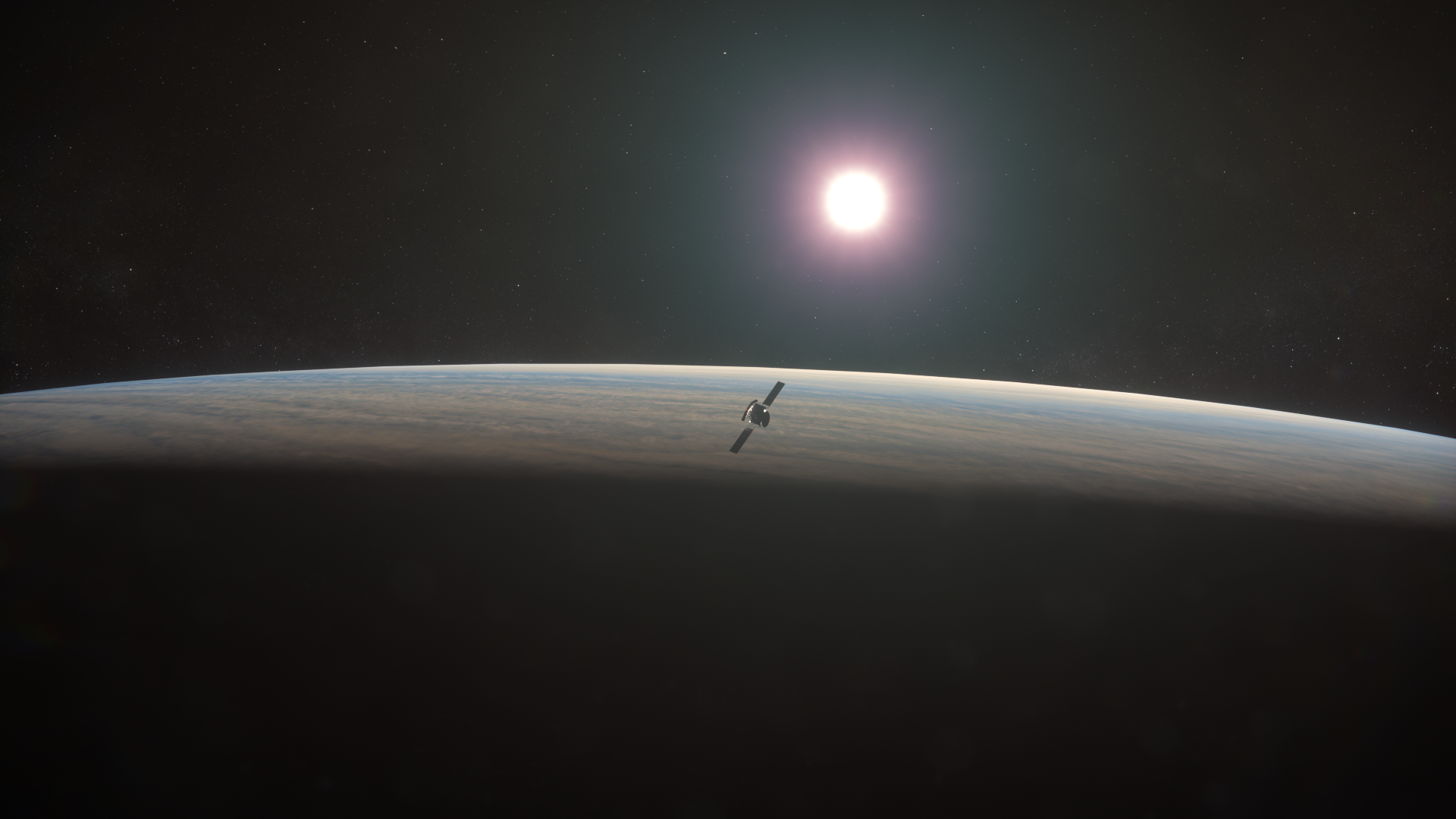
*Artist impression of ESA’s Envision mission at Venus. Credit: ESA/Paris Observatory/VR2Planets*
What puzzles Gillmann most about Venus?
Whether or not the interior of Venus is still wet somehow, whether there’s water in the interior because that makes a huge difference for whatever scenario we can think of for the evolution of the planet, says Gillmann.
If the interior is also dry, then it would be pretty clear that Venus would have lost all its water.
But if it’s wet inside, then the mystery continues, says Gillmann.