




It’s hard to think of a contemporary actor more attuned to the frequency of the oddball than Tony Hale. The 55-year-old actor has spent decades on both the big and small screens channeling his expressive face and chutes-and-ladders vocal timbre into all manner of awkward, neurotic characters: Think the endlessly infantilized Buster Bluth on “Arrested Development,” or Selina Kyle’s perpetually browbeaten aide Gary Walsh on “Veep,” or even his corporate HR director in Netflix’s recent rom-com “Office Romance.”
But for a generation of kids, now, Hale will always be known as the voice of Forky, the gangly, inquisitive spork introduced in “Toy Story 4” as the latest permutation of that series’ preoccupation with the existential nature of childhood and play. Unlike the factory-pressed plastic of Buzz Lightyear or the exquisitely-sewn felt of Woody or Jessie, Forky is simply willed into existence through the confluence of pipe cleaners, popsicle sticks, and the imagination of a little girl. And Hale’s performance perfectly captures the frenetic mix of terror and curiosity that comes with, well, being born yesterday. (Disney even channeled Forky’s newfound inquisitiveness into a series of Disney+ shorts called “Forky Asks a Question?”)
Six years on, Forky (and Hale) return for the Andrew Stanton-directed “Toy Story 5,” which sees Bonnie’s toys reckoning with the latest danger facing the nature of play: the rise of smart technology. This time, the focus turns to Joan Cusack’s cowgirl Jessie, whose attempts to reassert her and the toys’ place in Bonnie’s life in the face of a new iPad-like device named Lilypad (voiced by Greta Lee) put her face-to-face with her own abandonment issues.
Forky’s there, too, mind; he’s a bit more settled than in “4,” integrated into the rest of the gang, but also navigating the anxious early days of his marriage to fellow cutlery companion Karen Beverly (Melissa Villasenor). (You know what they say: Happy knife, happy life.) But despite Forky’s relegation to the background in “5,” he remains a vital part of the toybox, one that Hale keeps finding new angles to appreciate.
With “Toy Story 5” now in theaters, RogerEbert.com caught up with Hale to talk about Forky’s impact on a new generation of kids, the philosophical underpinnings of being a being navigating existence, and how characters like Forky, Buster, and Gary help him process and work through his own struggles with anxiety.
This interview has been edited for length and clarity.
You originated the role of Forky in 2019 when “Toy Story 4” came out. How does it feel to be returning to that 6, 7 years after you took the role?
That’s wild that it’s been 7 years, but if I’m honest, I was so overwhelmed the first time around. I’ve told the story that it wasn’t until I heard my voice in the trailer that I realized they hadn’t replaced me. I was convinced they were gonna replace me with a huge star. I heard my voice, and I was like, “Oh, they kept me.” I was in awe of Pixar, and still am.
So this time around, when I found out Forky was coming back and all this stuff, it was nice. I didn’t have that kind of anxiety attached to it. It was just kind of a fun playtime.
You’re also not as much of a narrative focus in this; you get to be part of the ensemble. In the intervening years, do you feel like you understand Forky better? Does Forky understand himself better?
Oh, I love Forky. Forky is kind of my role model. It’s funny because, even though it’s 2019, Forky has been such a part of my life. When I find out kids are fans, I’ll send them a little voice memo from Forky. I just love how Forky has impacted people. To me, he’s such a curious, open, very to-the-point, real character. I’d like to be a little more like that, you know?
How does it feel to kind of know or suspect that you might be some children’s first experience with existential dread? The question of, Who am I? How was I created?
[Laughs] I know. What I love, though, is that there’s not a darkness to it. He just wants to ask the question. Everybody wants to ask the question, but it doesn’t have to be such a heavy thing. He’s just like, yeah, what is a friend? Where am I, and who am I? What’s going on? The world can obviously be so divisive, and if we just got together and calmly started asking questions, I think we might see a little more unity.
What strikes me about Forky is that when he wants to go to the trash, you can read it as a very nihilistic kind of thing, but he just really wants to be there.
Yeah, he likes the trash. I think that’s another beautiful message of “Toy Story 4,” that there’s a part in all of us that thinks we are in the trash, you know? And it took Woody to say to Forky, “Hey, you’re meant to love and to be loved.” Who doesn’t want to hear that?
It’s kind of the most wholesome version of Frankenstein’s monster. There’s a little bit of Pagliacci in there, too, with Forky.
Dude, somebody needs to teach a class. You should teach a class. You should go to the university and teach a Philosophy on Forky course.
I was gonna ask you if you’ve read or considered any philosophy to get into Forky. Because I envision him as kind of a Buddhist, but, like, an Alan Watts Buddhist.
[Laughs] He’s so comfortable in himself, that would track.
The “Toy Story” franchise in general deals with questions of existence long before Forky even enters, and “Toy Story 5” is no different, not just about the nature of your creation, but your sense of usefulness in a world where technology claims to do a better job than you. Obviously, the toys-versus-tech thing is a major component of the plot.
As a parent yourself, I’m curious how those themes resonated with you, reading the script?
What I love about this whole situation is Pixar’s [approach], because they’re not going to do another “Toy Story” if there’s not a story to tell. They’re looking at the landscape of the world, and how technology’s not going away. But what they’re saying is nothing’s gonna replace true connection, true human connection. So even though technology wants to go awry sometimes, let’s always keep that balance.
I say that because, as a parent, I have preached this to my daughter, but I need to point the finger back at myself. I need to watch it, because the little ones, my daughter, they’re watching us. So as long as we can take care of ourselves, and really watch it ourselves, then, you know, hopefully it’ll unfold after that.
All of the toys exist in this spectrum between analog and digital, right? We even have other new characters that have kind of bridged the gap between the analog and the digital, as we’ll see. But Forky is the furthest on the spectrum. He’s not even a manufactured creation in a factory; he is the pure product of a child’s imagination.
You see in this movie a lot of times when you go into Bonnie’s imagination, and the animation changes, it’s super free and full of life. It’s fun to be a toy that was completely born of that wild, cool, free imagination she has.
And, Forky also has his own struggles in this movie: managing a relationship with Karen Beverly. Is Forky’s marriage the healthiest relationship one of your characters has ever had?
That’s a genius question. Okay, let me just track this.
I mean, Forky is kind of overwhelmed by and a little bit scared of Karen Beverly.
But I also love that, because he always keeps it real, and one of his lines is “I love her, but this is gonna be hard.”
Well, you know, they got married so young.
He works fast.
He was literally born yesterday.
And the only other married people he knows are the Potato Heads. And they’ve been around the whole franchise.
You think he asked them for marriage advice?
Oh, yeah. That’s “Toy Story 6,” the Potato Heads giving Forky and Karen Beverly marriage advice.
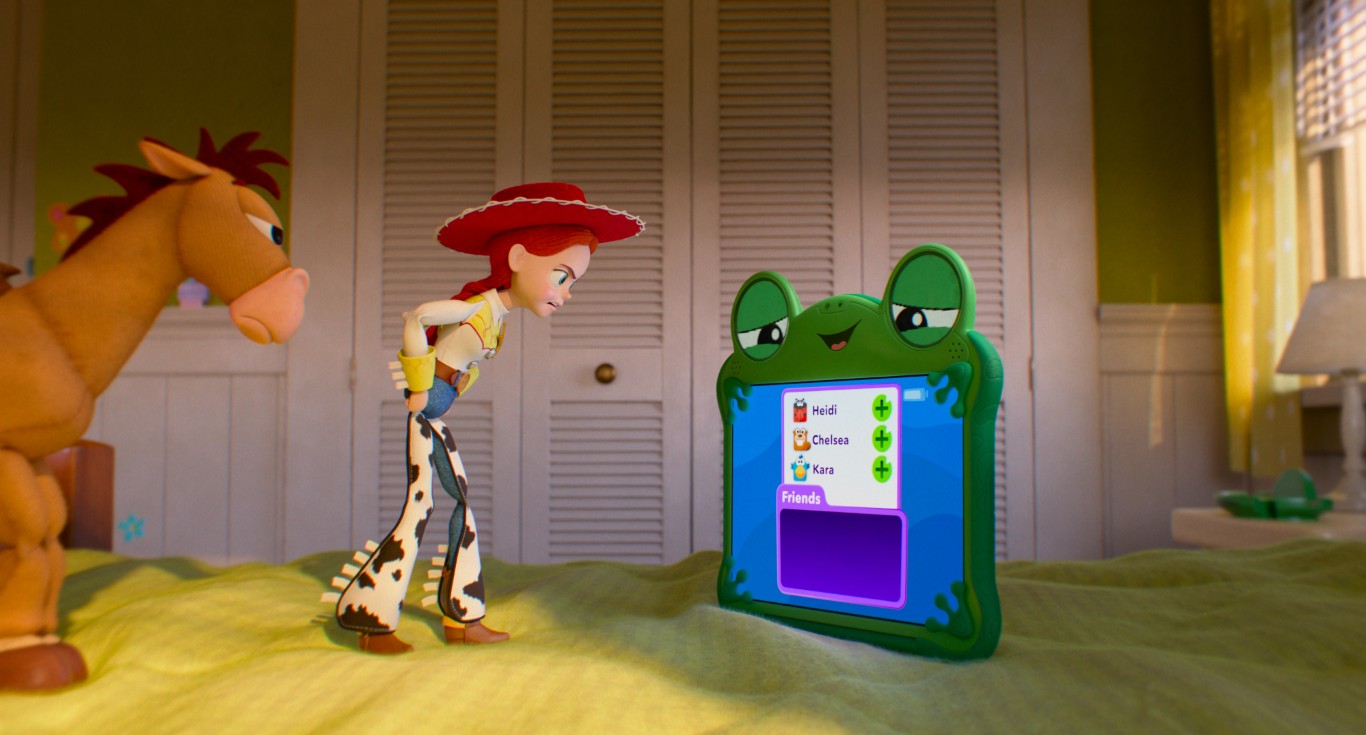
While Forky doesn’t get much chance to opine on the film’s conflicts, did you give any thought to what he thinks of the situation here and of Lilypad?
I think he would think of Lilypad much like he thought of Gabby Gabby in “Toy Story 4,” because Gabby Gabby was considered the evil doll, right? But he’s like, “I think she’s got pretty hair.” So Forky goes over and starts brushing her hair, and it’s because of that crossing of the line that Gabby Gabby had a redemption story. So, even though everybody’s against Lilypad, I think he’d be kind of like, “Huh. So, these buttons…what is… how do you swipe down? How do you swipe? What’s happening here?” He would just kind of be very curious.
I don’t think Forky would see her as a threat in the same way as the other characters would. And that tracks with a lot of your characters; you have obviously spent a career playing kind of the doe-eyed, innocent, and very cynical worlds: You operate so well in that register. There’s poor, mistreated Buster Bluth. It’s Gary in “Veep” just getting absolutely abused by Selina. They’re just trying to keep up and earn the approval of characters who just won’t give them the time of day. What draws you to those characters? What do you find in those people?
If I’m honest, it doesn’t come out of nowhere. Having done Buster, Gary, and a lot of other beaten-down characters. I grew up around anxiety, and had my own struggles with school and all that kind of stuff. And I grew up also loving Bob Newhart and Tim Conway.
Bob Newhart, specifically, would just stand there in his anxiety, and it was funny. You could see the tension in his face, and I feel like that’s how anxiety lives in our bodies, you know? There’s a war going on inside, but you keep it together on the outside, and it’s peeking through. That, I feel, is a lot of my characters, especially Gary.
In those scenarios, for you as a person, what gets you through those moments of anxiety?
I mean, a lot of therapy. I did a lot of cognitive behavioral therapy. [Laughs] But if I’m honest, most of my growing up, I think I was pretty checked out. I was in my own imagination. In different scenarios, I would escape. Later in life, I started to get a little more present and to activate. This one therapist would tell me to activate the five senses. What are you seeing, smelling, tasting, hearing, and touching? To ground myself.
Cut to, I do “Inside Out 2,” playing Fear, and they actually have this little girl having what’s similar to, like, a panic attack in the end. She wakes up out of it through her senses. It’s pretty cool how art sometimes imitates life.
It is a very interesting matrix of emotions you have to convey purely through your voice, especially because you, in live action, are such an expressive performer. Your face is so much of your instrument. I’m curious how you thrive or work around the limitations of having only one element to work through.
I was very nervous about that when I started doing animation years and years ago. Just the fact that it’s just a mic in front of you. I was so used to being able to use the nonverbal, my physicality, to show the anxiety with my eyes. And then I have to relay that through that microphone. I woke up to the fact that, “Oh, I’m gonna do the same performance in front of this mic as I do in front of the camera.”
I just go crazy in the booth. If anything, I take the performance I do on camera and just put it on steroids. And many times, the voice director would have to be like, “Hey, Tony, you gotta stay close to the mic.” You gotta stay close to the mic.”
It’s unfortunate that we’re not getting a new set of “Forky Asks a Question?” for “Toy Story 5.” But what questions do you think Forky still has to ask?
Many. I mean, what I love about the first set was so simple, and it was so because he might have a lot of questions now about relationships. About technology. The great thing is, Forky can be the tool when we’re sometimes afraid to ask. It’s a bummer that there’s shame attached to asking questions, and thankfully, there’s a character like Forky who just doesn’t have that shame.
Out of the mouths of cutlery, you know?
[Laughs] That’ll be the name of his book.
In addition to Toy Story, I wanted to ask you about another recent film you did that explores a similar sense of play: “Sketch.“
That was a passion project, big time.
What were you working out with that one, in terms of the same instincts of play and things like that?
That took us 8 years to make, and Seth Worley, who directed and wrote it, had just been trying to get it made for so many years. I believed mainly in Seth, just wanting this whole marriage of, like, we described it like “Inside Out” meets “Jurassic Park,” about this girl who draws drawings, and they come to life. What Seth did so beautifully is that it’s this ordinary world, and then the supernatural just bashes into it, you know?
There’s a big grief message in it, and how to grieve. Of the things in my work and my career, that’s very much at the top of the list.
Hopefully, it’s not another 6-7 years before you get to play Forky again, but where would you like to see Forky go in a theoretical follow-up?
Travel him. Just, like, put him on a boat and just travel him around the world and just see where that takes him. I would like some kind of Forky companion to be like, “Hey man, I don’t know if I’m comfortable asking this.” He’d be like, “Yeah, game on. No shame, let’s do it.”
Have people in Europe even seen a spork? I don’t know.
I should get it trending. That has not gotten enough of the spotlight. We need some more sporks.
What else are you working on right now?
I’m about to start this Nancy Meyers project with Jude Law, Owen Wilson, and Penelope Cruz, which is very exciting. I just moved to Alabama. My wife’s family is from there, and we had been in LA for, like, 21 years, and we needed to be closer to family. So, that has been awesome, and a big change.
I mean, if the “Toy Story” movies have taught us anything, it’s how to deal with change.
Yeah, I’m not great at it, but I’m trying to get better.