




The nail cleaner dates to between 300 and 400 C.E., when Britain was part of the Roman Empire — and phalluses were seen as good luck charms, not obscene symbols.
Archaeological Research Services Ltd.This ancient nail cleaner with a phallus for a handle was unearthed near Cheltenham, England.
Since October 2025, archaeologists in England have been excavating a site near Cheltenham ahead of a road improvement project. In the past few months, they’ve uncovered a trove of historical artifacts, but their most recent discovery may be the most intriguing of all.
Excavations just revealed a copper nail cleaner dating back to Britain’s late Roman period, between 300 and 400 C.E., not long before the empire fell. The blade looks similar to many nail cleaners on the market today — but the handle is a large phallus. Now, this find is providing a fascinating peek into Roman culture and how phallic symbols have evolved over time.
The Phallic Nail Cleaner From The Roman Era That Was Uncovered In England
The latest work at the archaeological site near Cheltenham, England, revealed a variety of relics spanning thousands of years. Ditches, tracks, a well, and pits full of domestic debris suggest that the site was settled for a large span of history — perhaps up until the modern era.
The nail cleaner was discovered among these artifacts. The small copper tool features a forked blade on one end and a detailed phallus on the handle. The phallus has a loop on the side, perhaps so it could hang from a belt or alongside other implements.
During Roman times, the phallus wasn’t seen as an obscene symbol. Instead, it was a sort of lucky charm. The symbol could be found on military equipment, household items, and jewelry worn by men, women, and children. Young Roman boys wore a bulla, a type of locket with a phallic amulet inside that was meant to bring good luck.

Archaeological Research Services Ltd.Excavations began in the fall of 2025 ahead of a road improvement project.
Phalluses were thought to ward off the “Evil Eye,” safeguard wearers from curses, and promote fertility. In 2020, a metal detectorist unearthed a silver phallus pendant on an English farm. And excavations in Spain revealed an 18-inch-long phallus carved into the foundation of an ancient building. Phalluses have even been found carved into Hadrian’s Wall to protect vulnerable spots from invaders.
It wasn’t until the widespread adoption of Christianity in the fourth century C.E. that the phallus came to be seen as a vulgar object, as the Church denounced pagan symbols and rituals.
Similar nail cleaners from Roman Britain have been found in the past, but Archaeological Research Services — the company behind the discovery — stated that this artifact “may be the finest example known.”
And it’s just one of many incredible relics that have been uncovered near Cheltenham in recent months.
Other Historical Discoveries From This Road Expansion Project
Alongside the phallic nail cleaner, archaeologists unearthed a copper belt buckle from the same time period. The D-shaped buckle is attached to a single folded metal plate engraved with geometric designs.
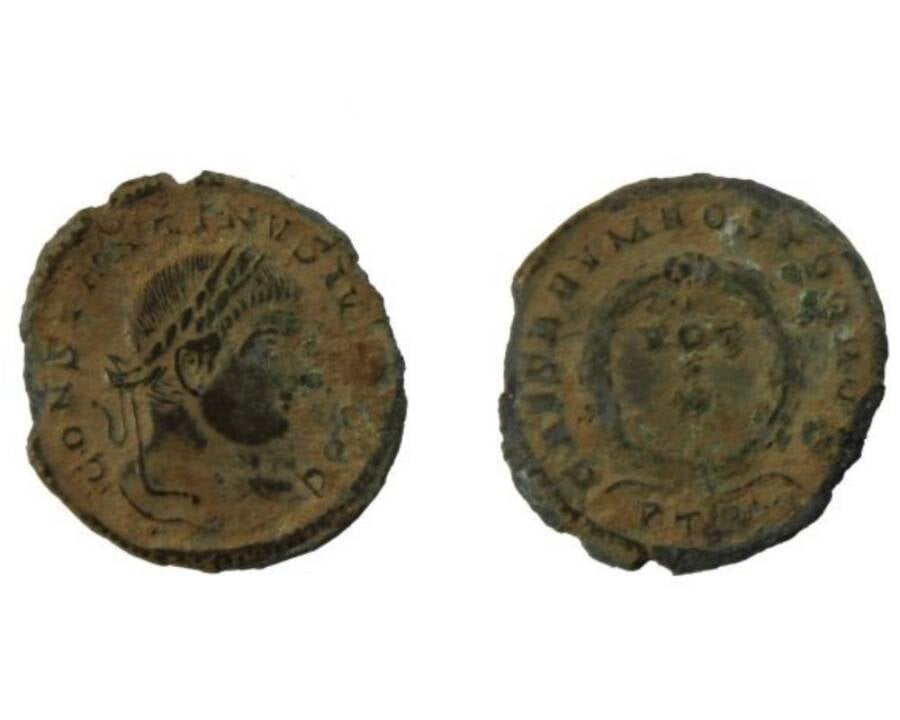
Archaeological Research Services Ltd.Bronze coins issued during the reign of Emperor Constantine I.
They also discovered a trove of coins spanning 2,000 years. An Iron Age coin from the ancient Celtic Dobunni tribe that lived in the area before the Roman conquest features a horse motif common in this society. Excavations also revealed bronze coins issued by Emperor Constantine I — the ruler who spread Christianity throughout the empire — and medieval pennies from the 14th-century reign of King Edward II.
There were more modern discoveries at the site, too, such as an 18th-century “dandy” button issued by the British Navy. These finds suggested a period of extended habitation before industrialization transformed the land.
Indeed, archaeologists have also uncovered human remains in the area. One burial, dating to the fourth century C.E., included grave goods ranging from Roman coins featuring Romulus and Remus with the She-Wolf to a copper bracelet still adorning the skeleton’s wrist.
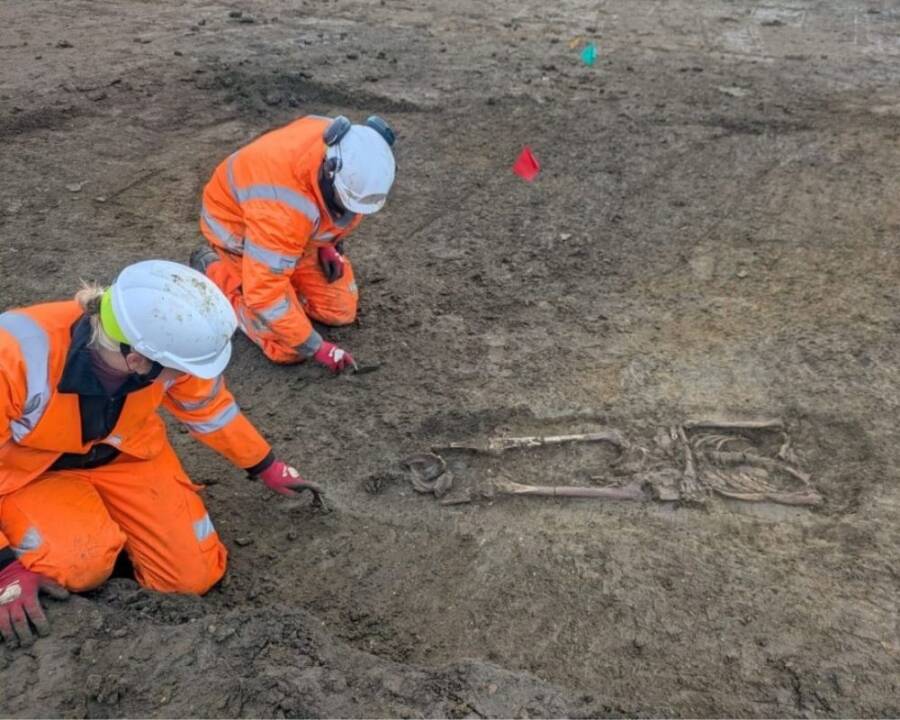
Archaeological Research Services Ltd.The skeleton buried with its skull placed between its knees.
A second burial was even more curious: The skull had been removed and placed between the knees of the deceased. So far, there is no information on the age of the remains, but this practice has been seen before in the late Roman era.
Overall, the discoveries made outside of Cheltenham reveal the rich history of Britain both during and after the time of Roman rule.
After reading about the ancient phallic nail cleaner discovered in England, see the 1,800-year-old phallus charm unearthed at an English cricket club. Then, look through some of the explicit frescoes that once adorned Pompeii.