




The creator economy was worth roughly $250 billion in 2024 and could reach $480 billion by 2027, according to Goldman Sachs Research. A big slice of that money flows through apps that connect creators with brands. Pick the right one and you turn an audience into income. Pick the wrong one and you waste months chasing free samples.
I’ve taught influencer marketing at UCLA Extension for years and work with brands on creator programs in my role as a Fractional CMO and influencer marketing educator. So I want to be straight with you about something most “best apps” lists won’t admit: this space churns. Two of the apps I’d have pointed you to a few years ago have already shut down. Below are the eight I’d actually recommend in 2026, grouped by what you want out of them, plus the ones I’d skip and why.
Key Takeaways
✅ The creator economy could hit $480 billion by 2027, and most creators earn through brand deals, which account for about 70% of creator income per Goldman Sachs.
✅ Choose an app by the outcome you want: commission on sales, paid campaigns, free product to review, or an ongoing ambassador role. Most pro creators run more than one.
✅ For earning commission on what you recommend, LTK and ShopMy lead, with the Amazon Influencer Program a strong third for product-heavy niches.
✅ For paid brand campaigns, register on a marketplace like IZEA or TRIBE so brands can find and book you.
✅ Free product counts as a “material connection,” so the FTC requires you to disclose it, even on gifting apps that never pay cash.
✅ Skip the dead and the thin: Collabor8 has shut down, Octoly is now folded into Skeepers, and a follower count under 1,000 limits what most paid apps will offer you.
How do influencer apps actually help you make money?
Influencer apps are platforms that connect creators with brands for paid collaborations, commissions, or free product. They handle the matching, the contracts, the payments, and the tracking so you don’t have to cold-pitch every brand yourself. Some pay cash, some pay a cut of sales, and some only send product. The model you pick decides how you get paid.
That distinction matters more than any feature list. If you want to understand how influencers make money across the board, brand deals are the largest piece, and what an influencer actually earns depends heavily on which model fits your audience. Goldman Sachs found that only about 4% of global creators pull in more than $100,000 a year, and the ones who do almost always combine several income streams rather than relying on one app.
In my book The Age of Influence, I argued that the strongest brand partnerships behave like relationships, not one-off transactions, and that smaller, highly engaged creators often outperform the big names on trust and conversion. The best apps reflect that. They reward consistency and genuine fit over raw follower counts. For the wider context on where the money is moving, my running tally of influencer marketing statistics is worth a look before you commit to a platform.
Here is how the four models compare at a glance:
| What you want | How you get paid | Best apps |
|---|---|---|
| Earn on what you recommend | Commission per sale | LTK, ShopMy, Amazon Influencer Program |
| Get booked for campaigns | Cash per post/campaign | IZEA, TRIBE |
| Try and review products | Free or discounted product | Influenster, ExpertVoice |
| Become a brand ambassador | Mix of product, cash, perks | SocialLadder |
Which influencer apps let you earn commission on what you recommend?
Commission apps let you tag products in your content and earn a percentage of every sale your links drive. You don’t wait for a brand to book you. You monetize the recommendations you already make. This model rewards creators with engaged, ready-to-buy audiences, and it scales with your content rather than your inbox.
LTK is the established leader. Its average commission runs 10% to 25% and can reach 30%, with access to a catalog of more than a million brands. LTK leans selective, asking for an engaged public following of at least 5,000 and high-quality posts a few times a week, which is why many creators treat it as the premium tier of affiliate work.
ShopMy has become the other name every creator mentions, and is now valued at $1.5 billion, as Fortune reported in May 2026. Its co-founder Tiffany Lopinsky put the shift plainly to Fortune: “The influencer is a retailer, a mini-Saks, a mini-Bloomingdale’s.” ShopMy accepts creators from 1,000 followers, pays out weekly, works with 47,000-plus brands, and lets you link almost any brand even without a formal partnership. Most creators I talk to run LTK and ShopMy side by side rather than choosing one.
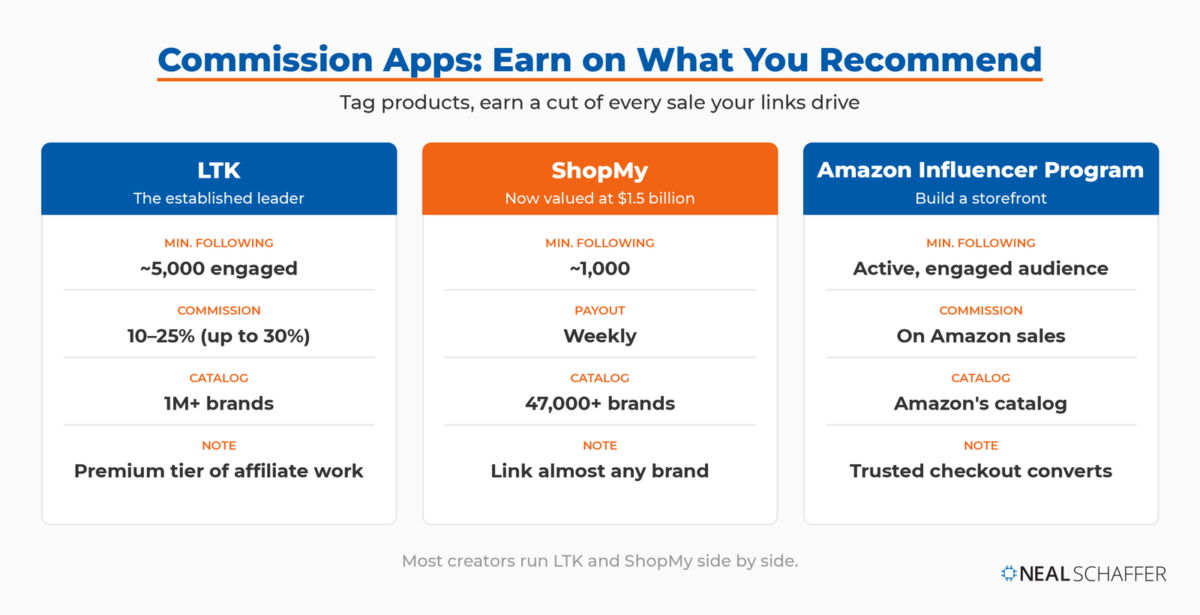
The third option is the Amazon Influencer Program, which lets you build a storefront and earn commissions on Amazon’s enormous catalog. Commission rates are lower than fashion-focused platforms, but the trusted checkout converts well, especially for everyday product niches. If you’re going the Amazon route, getting set up as an Amazon influencer takes a few specific steps.
Which apps get you booked for paid brand campaigns?
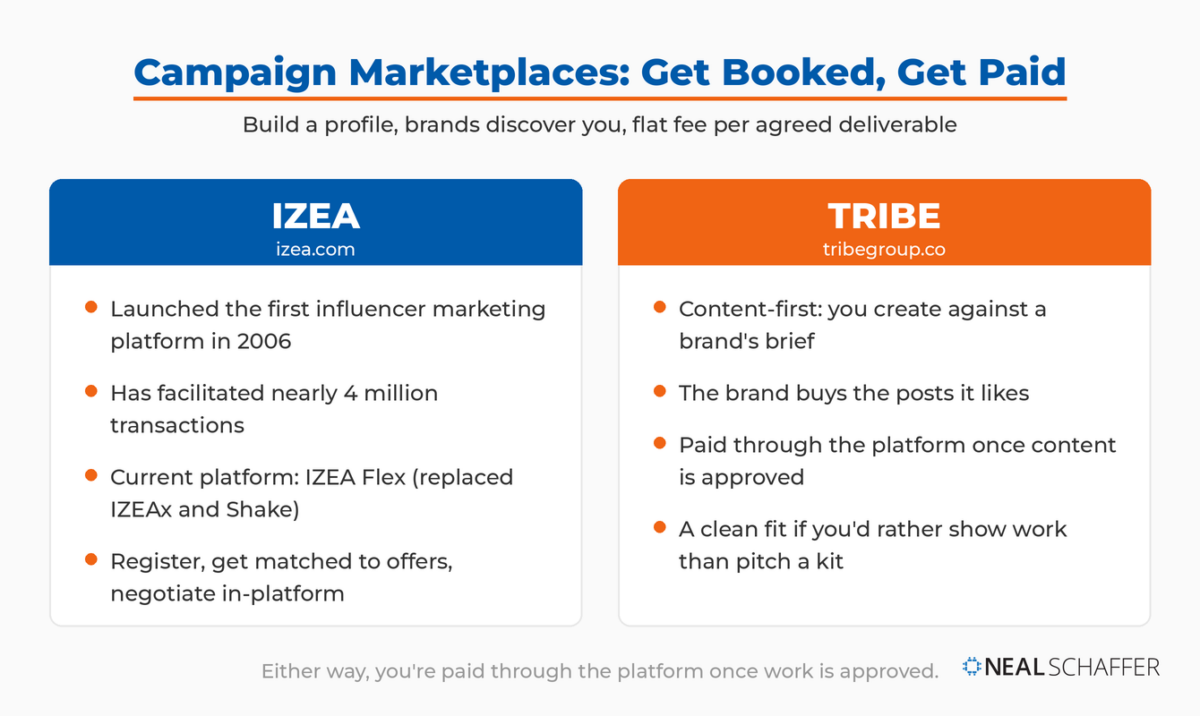
Campaign marketplaces work the opposite way from commission apps. You build a profile, and brands discover you, send offers, and pay a flat fee for agreed deliverables. This suits creators who’d rather be hired for a defined scope than earn on sales volume. You set your terms and get paid through the platform once work is approved.
IZEA launched the first influencer marketing platform back in 2006 and has facilitated nearly four million transactions since. Its current platform, IZEA Flex, replaced the older IZEAx and Shake products that the legacy version of this post referenced. As a creator you register, get matched to brand offers, and negotiate inside the platform. IZEA (NASDAQ: IZEA) sits more on the brand side now, but registering keeps you visible to the agencies and companies running campaigns through it.
TRIBE takes a content-first approach. You create a post for a brand’s brief and submit it, and the brand buys the ones it likes. You’re paid through the platform once your content is approved. It’s a clean fit if you’d rather show finished work than pitch a media kit. Either way, having a strong influencer media kit and a realistic influencer rate card ready will help you win and price these campaigns.
Which apps send you free product to try and review?
Product-sampling apps give you free or discounted product in exchange for honest reviews and content, usually with no cash payment. They’re a sensible entry point if your following is still growing, because most accept creators with modest audiences. The trade-off is real: you’re paid in product and access, so treat them as portfolio building, not a paycheck.
Influenster, owned by Bazaarvoice, sends qualifying members “VoxBoxes” of complimentary products to try and review across a huge range of categories. You don’t need a large social following because reviews live on the platform itself, which makes it friendly to beginners and everyday shoppers who simply post a lot.
ExpertVoice is built for credentialed experts, including retail associates, athletes, and verified specialists, who recommend products in their field. Instead of cash, you get deep discounts on gear in exchange for learning about and recommending products. If your influence is rooted in offline expertise, it’s one of the better fits I know of. Just remember that free product and discounts both count as a relationship you have to disclose, which I’ll come back to below.
How do brand ambassador programs work?
Brand ambassador apps turn a brand’s own fans and customers into a recruited, managed community of advocates. Rather than one-off posts, you take on an ongoing role, completing tasks, sharing referral links, and earning a mix of product, commission, and perks. These programs reward loyalty and consistency, so they fit creators who already love and use a specific brand.
SocialLadder is the platform I see most often on the management side of this. Brands use it to find, onboard, and reward ambassadors and to track what those ambassadors drive. One useful reality check from SocialLadder’s own research: a small core of ambassadors tends to generate the large majority of results, so brands increasingly favor a focused, engaged group over a giant roster. If you’re a genuine superfan of a brand, getting into its ambassador program can be more durable than chasing scattered one-off deals.
How do you choose the right influencer app?
Match the app to the outcome you want, then to your audience size and niche. If you want income now from an engaged buying audience, start with a commission app. If you’d rather be hired for defined work, register on a campaign marketplace. If you’re still growing, sampling apps build your portfolio. Follower count and niche narrow it further.
Make LinkedIn Your Best Source of Clients
My latest book helps professionals, entrepreneurs, and business owners turn LinkedIn from a static profile into a real source of clients and growth.
Maximizing LinkedIn for Business Growth gives you clear, practical steps to build a profile that gets noticed and a network that actually sends business your way.
Grab your copy on Amazon and put it to work this week. Click the cover or the button below to get started.

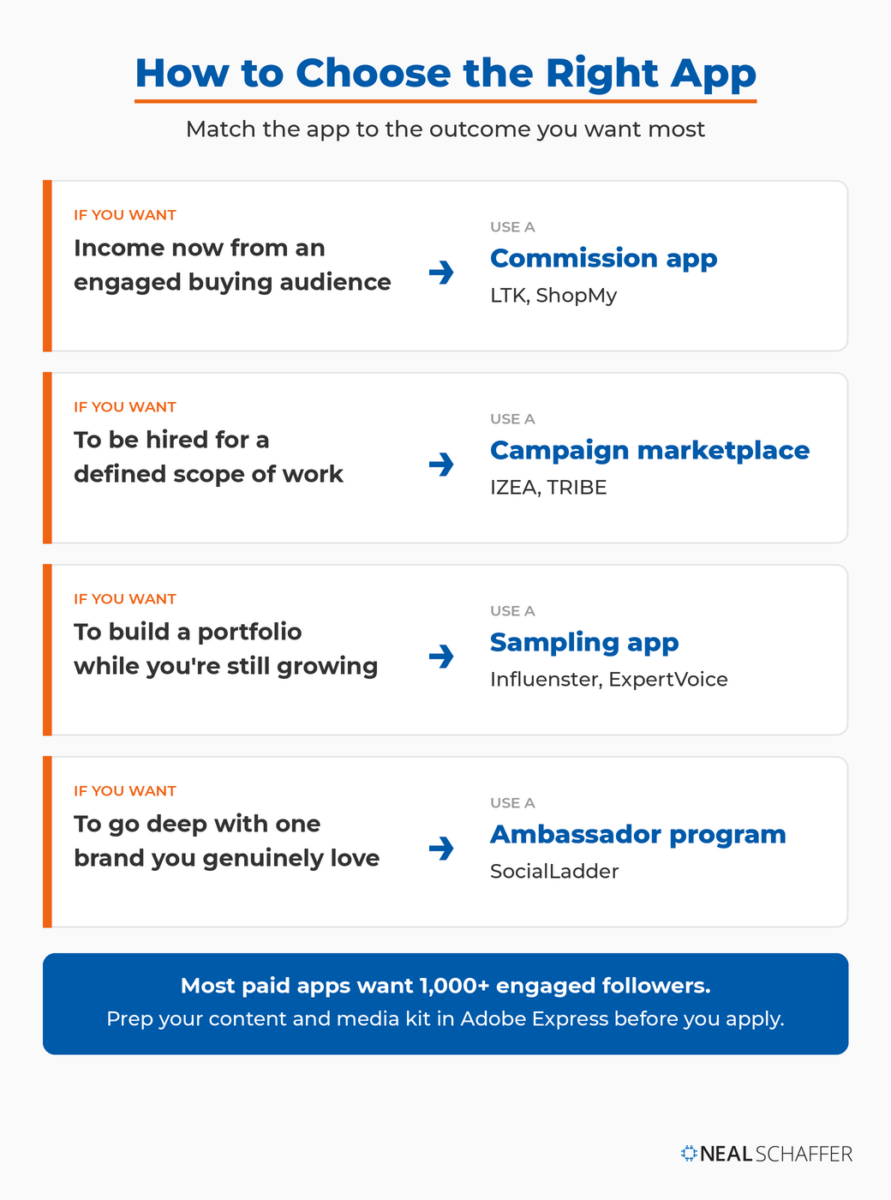
A few honest rules I’d give any creator. First, your audience size sets your options: most paid apps want at least 1,000 engaged followers, and the better-paying ones expect more. It pays to understand the different tiers of influencers and where you sit, since micro-influencers often win on engagement even against far larger accounts. Second, run more than one app, because most professional creators stack a commission platform with a campaign marketplace. Third, get your assets ready before you apply. You’ll need clean content and a media kit, and the design tool I actually use for both is Adobe Express, which is faster than Canva for the social-sized graphics these pitches need.
Worth knowing too: these creator-side apps are the flip side of the broader influencer marketing tools and the influencer databases that brands use to find you. Understanding both sides helps you build a smarter influencer marketing strategy and present yourself the way brands are already searching.
| App | Model | Min. following | How you’re paid |
|---|---|---|---|
| LTK | Commission | ~5,000 | 10-25% (up to 30%) per sale |
| ShopMy | Commission | ~1,000 | Weekly commission per sale |
| Amazon Influencer Program | Commission | Active, engaged audience | Commission on Amazon sales |
| IZEA / TRIBE | Campaign marketplace | Varies by offer | Cash per campaign |
| Influenster / ExpertVoice | Sampling | Low / expertise-based | Free or discounted product |
| SocialLadder | Ambassador | Varies by brand | Product, commission, perks |
One non-negotiable across all of them: disclosure. A “material connection” includes a brand paying you or giving you free or discounted products, and the responsibility to disclose sits with you, not the app or the platform’s built-in tool. That applies as much to a free VoxBox as to a paid campaign. The FTC influencer guidelines lay out what to disclose by post type.
Which influencer apps should you skip?
Skip apps that are dead, rebranded into something else, or too thin to pay. The biggest risk with any list of best influencer apps is that half the entries no longer work as described, because this category consolidates constantly. Before you invest time, confirm an app is still active, pays as expected, and attracts brands in your niche.
Two names from the older version of this very post are instructive. Collabor8, once billed as the “Tinder of influencer marketing,” has shut down entirely, with its own site now posting a closure notice. Octoly, the beauty-focused gifting platform, was acquired and folded into Skeepers back in 2021, so the standalone product no longer exists. The churn isn’t limited to small players, either: Popular Pays was absorbed into Lightricks and now skews to the brand side, and longtime affiliate networks have wound down with little warning.
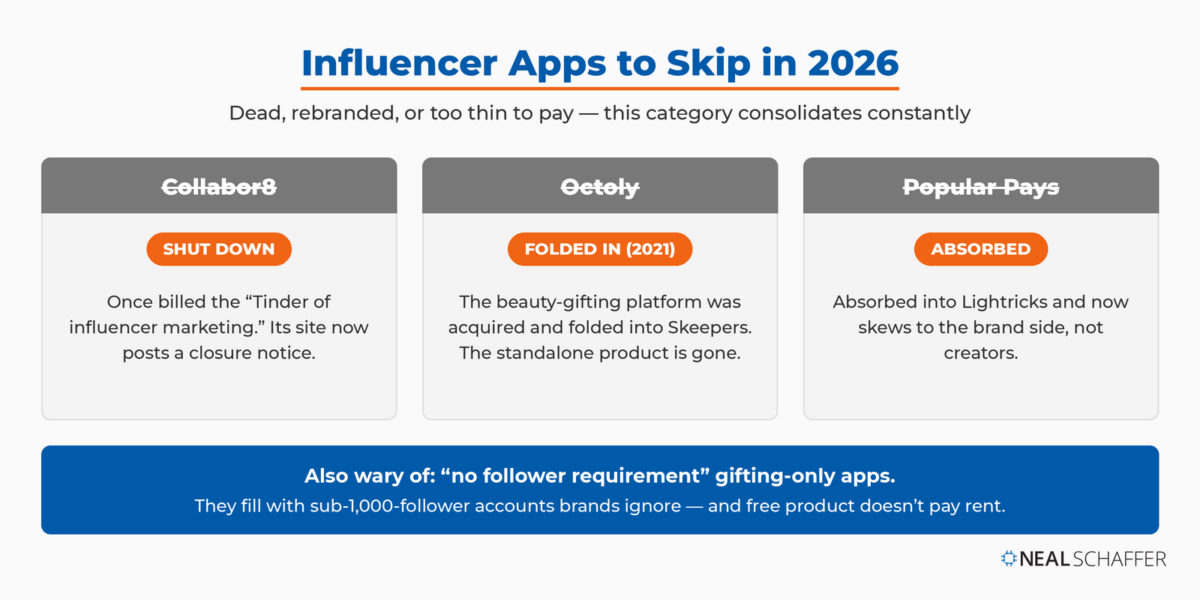
I’d also be cautious with gifting-only apps if you actually need income. Free product is fine when you’re building a portfolio, but it doesn’t pay rent, and apps with no follower requirement tend to fill up with sub-1,000-follower accounts that brands ignore. If income is the goal, weight your time toward the commission and campaign apps above, and treat sampling as a supplement.
Frequently Asked Questions
For beginners, a sampling app like Influenster or a low-barrier commission app like ShopMy, which accepts creators from around 1,000 followers, is the easiest start. You build a track record and content before the higher-bar platforms like LTK become realistic. Run a couple at once to see which fits your niche.
Most creator-side apps are free to join and take their cut elsewhere. Commission apps like LTK and ShopMy are free for creators and earn from brand relationships. Campaign marketplaces typically take a margin on the brand’s budget rather than charging you. Always read the terms, since a few niche apps charge subscription fees.
It depends on the app. Sampling platforms like Influenster have little or no follower requirement, ShopMy starts around 1,000, and LTK looks for at least 5,000 engaged followers. Engagement and content quality often matter more than raw numbers, which is why smaller creators still get accepted and booked.
Yes, and most professional creators do. A common setup is one commission app for everyday sales and one campaign marketplace for paid brand deals, since they monetize different parts of your audience. Running two or three at once lets you see which fits your niche before you commit your time to any single platform.
Yes. The FTC treats free or discounted products as a material connection, so you must clearly disclose it even when no cash changes hands. That includes Influenster VoxBoxes and ExpertVoice discounts. The responsibility is yours as the creator, and a platform’s built-in label alone is not enough.
Put These Influencer Apps to Work
Start with the outcome you want, then pick one commission app and one campaign marketplace and build real profiles on both. Get your content and media kit ready first, disclose every paid or gifted relationship, and give it a few months of consistent effort before you judge whether an app is working. The creators who win here treat this like a business, not a lottery ticket.
If you want to see where the money and momentum are actually heading, my regularly updated creator economy statistics are worth bookmarking. And if you’d like to go deeper on building genuine influence rather than chasing one-off deals, grab a free preview of The Age of Influence or join the conversation inside my Digital First Mastermind community, where creators and entrepreneurs work through exactly these decisions together.
Actionable advice for your digital / content / influencer / social media marketing.
Join 13,000+ smart professionals who subscribe to my regular updates.