




Early on in Todd Haynes’ “Safe,” an unwatched television broadcasts a half-heard report on Elizabeth Bouvia, a woman paralyzed by cerebral palsy and stricken with degenerative arthritis. Bouvia became a figurehead for the American right-to-die movement in the 1980s. She wanted ultimate control over decisions made about her body and went to court, and then appellate court, to win it. Even with the help of the ACLU, she was denied it. The hero of “Safe,” delicate, beautiful, WASPish Carol (Julianne Moore) wears a pained look as the Bouvia report unspools in the background.
This is Haynes expressing his thesis. Carol doesn’t have control over her body, either. She’s centered as she will be often throughout the film at the exact middle of the frame. Haynes and his cinematographer Alex Nepomniaschy (“Lisa”) will shrink the environment around her with slow zooms, with doorways, window panes, environmental elements to underscore how trapped Carol is: a prisoner of a society designed to degrade women into specific roles while requiring from them a narrowly-prescriptive appearance constructed from a combination of makeup, the wardrobe of the moment (all those Olivia Newton-John “Physical”/Jane Fonda Workout leotards!) and body modification. Haynes frames Carol the way a lepidopterist preserves pretty butterflies. Throughout “Safe,” she is carefully arranged, posed for undignified post-mortem display, cold and formulated to a frame for all to see in her exquisite loveliness.
Todd Haynes, a poet of women in crisis, first came to my notice as a rumor, a cautionary tale about a brilliant young filmmaker who made a movie that attracted the wrong kind of attention from a major corporation. After his discomfiting queer portmanteau “Poison” (1991) became a minor arthouse sensation, stories about his “first first” film, a “lost” film started making the rounds.
His 1987 “Superstar” is ostensibly a biopic of doomed singer Karen Carpenter, made on a shoestring of a shoestring, an experimental exercise using plastic kid’s dolls to play out Carpenter’s rise to fame and death from anorexia nervosa. I saw it on a bootleg VHS cassette ordered through mail order from a catalog warehouse operating out of Florida. It arrived in a plain, brown, paper package like all the best contraband does. I heard “Superstar” had been suppressed because of a lawsuit filed by Mattel, the company that owns Barbie, a few of which Haynes had progressively shaved down with a razor to stand as the singer at different stages of her emaciation.
In reality, it was the Carpenter estate that prevented the film’s release because of how Richard Carpenter was represented as callous, even complicit in Karen’s growing self-consciousness in the public eye. After all, Haynes argued, most of the dolls weren’t Mattel’s anyway. “Superstar” is a masterpiece. It’s the film I thought of often as the corrective for Greta Gerwig’s well-intended but unfocused “Barbie.” It’s a film about eating disorders that provides neither flesh to fetishize nor behaviors to imitate and it pinions the role of well-intentioned loved ones who in their love and desperation say the wrong things at exactly the wrong times. The rode to hell is paved with well-intended loved ones. Haynes understands the crucible of being looked at for women. In our culture, a woman’s value is often inextricable from her attractivity according to some arbitrary set of goalposts in constant brownian motion. Impossible to ever truly conform or to conform for long, in our culture, the cruel irony is how the only thing truly unforgivable is to fail to conform.
The first shot of “Superstar” is the discovery of Carpenter’s body through a half-open door. She, like “Safe’s” Carol is trapped in an architectural element offset within the frame of the film. Even here, he suggests, on this screen with them as the star, they are fragmented by our leering and comparing of their component parts. Haynes, from the start, has been a voice for those yearning to be seen as fully three-dimensional in a culture conditioned to see some only in one, maybe two dimensions.
For his Bob Dylan biopic “I’m Not There,” Haynes plays with our familiarity with the singer’s appearance by casting six actors, including a woman, Cate Blanchett, to portray him as six individual personae throughout the course of his mercurial career. If we stop looking at him, we can finally see him. In “Carol,” (2015) he reunites with Blanchett in a forbidden sapphic romance presented as a lush Douglas Sirk melodrama, a bookend to his “All That Heaven Allows” (1955) spiritual remake “Far from Heaven” (2002). Each are about the most vulnerable (not just women, but gay women) being forced into hiding in plain sight. Each are about the rapture of finally being recognized through the disguises you’ve been forced to assume. And the villain of each of his films is the oppressive influence of the “male gaze.”
Godard once referred to watching movies as a criminal act. From a dark place, we peer through a lighted square at the most private moments of people who are helpless but to be observed by us. Haynes understands the irony of making films—a thing to be looked at—about the oppressive horror of being looked at. Watch how Carol seems aware she’s under scrutiny and so is constantly performing in “Safe.” Nervous. Hungry for affirmation. Terrified of disappointing. The demand of maintaining a facade wears her down to a nub.
Carol’s husband Greg (Xander Berkeley) makes her sick. She lays prone and lifeless during sex. She vomits when he pulls her into an embrace. She blames his cologne (he’s not wearing any) or his clothes. Really, it’s just him. Mark the times Carol’s illness flares throughout “Safe.” She has a bad episode after he compliments her new perm. She gets a nosebleed after getting the perm in the first place, the new style an impulsive act while waiting at her spa for a hair appointment and a manicure. She’s done it for herself, but all Greg sees is a new kink for his married libido.
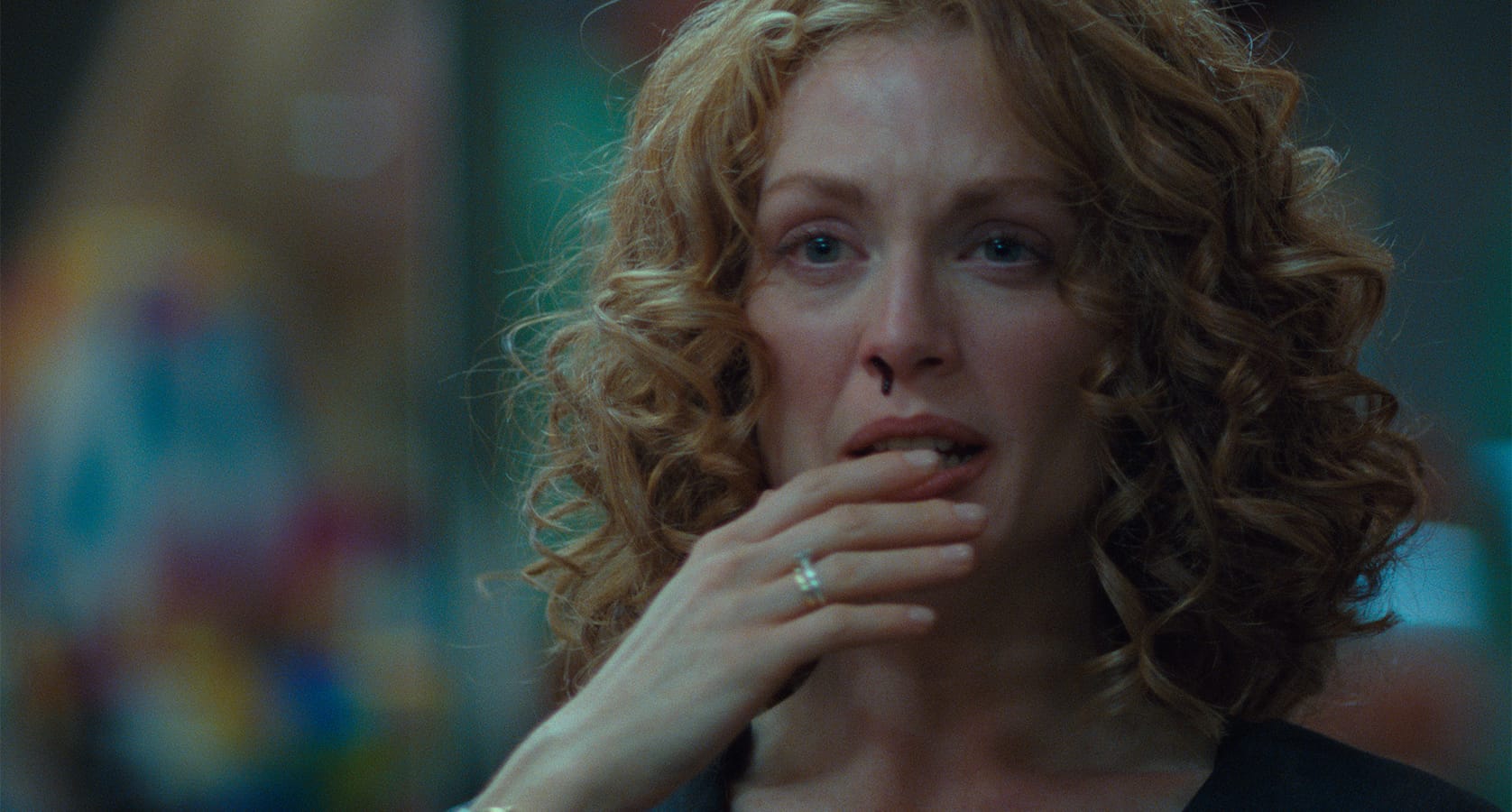
The sequencing of Carol’s attacks (sneezes to rashes to shortness of breath and worse) mirrors the rhythms of Alfred Hitchcock’s cadence of attacks in “The Birds” (1963). In that film, a strong woman, notorious for her disdain for the norms of an abusive patriarchal society, gradually surrenders to them at the beckoning call of domesticity. Like Carol, Hitchcock’s heroine Melanie (Tippi Hedren), aquiline and startlingly beautiful by contemporary standards (she’s introduced in the film with a wolf whistle), is punished by avatars of the environment at every step along the path of her voluntary weakening and assimilation.
In “Safe,” Carol’s punisher for her surrender to her diminishment isn’t birds, but “environmental illness,” a catchall diagnosis favored by wellness cult leader Peter (Peter Friedman) in whose remote New Mexican retreat Carol institutionalizes herself. It’s her last resort after being patronized and dismissed by doctors; gossiped about and clucked over by her hollow, competitive and jealous friends; even rejected by a child at a baby shower towards whom she tries to be maternal. Yes, Carol is allergic to her environment. Her environment is the hostile superficiality of the suburbs.
Note how the other patients at Peter’s compound are largely women and minorities—all save gentle Chris (James Le Gros) who represents a softer kind of masculinity that respects Carol’s need for physical space and time to heal. He walks her to the hermetically-sealed bubble she’s taken over and doesn’t try to lean in for a hug or a buss on the cheek. He doesn’t force himself on her the way her husband, even though Greg’s proximity to Carol causes her obvious discomfort, does. Chris doesn’t think Carol is irritating. He would never use a word like “hysterical.” He seems to know that Carol’s illness has something to do with her being forced to be something that she isn’t. That’s what she’s sick of.
As Carol, Moore, in her breakout role, is extraordinary. She’s an exposed nerve, twitching with every minor shift in the air. After an aerobics class her friends marvel that Carol doesn’t sweat and Carol shrinks as though she’s been chastised. She doesn’t conform to the norm even in perspiration and non-conformance is wrong. No one can see Carol because Carol is the prettiest girl in the room.
One night, alone in her room, a stone dislodges in her and Carol sobs as though her heart has broken. Another patient finds her, an older woman, and tells her that all the feelings that Carol is feeling are “just fine.” It’s possibly the first time anyone has ever told Carol that whatever she feels is okay to feel. I say this as a child of abuse that the requirement to not feel “wrong” is hardwired into some of us. The need to appease in order to avoid attention supercedes personal care to the extent that it becomes hard to even know what it is you do feel. You start to wonder if you can feel anything at all. Carol is starting to accept herself here. The end of “Safe” is her breaking the fourth wall—a “no-no” in a medium dominated by a male gaze that despises being recognized—and repeating “I love you. I really love you” to, essentially, us, her unobserved observers. In seeing herself, she sees us, too. I wonder if it’s true in the reverse. “Safe” is a prayer for acceptance, you see. For Carol. For us. Amen.

Criterion’s 4K restoration of “Safe” has been overseen by Haynes. Its uncompressed (the real VIP in 4K technology) mono soundtrack haunts with Brendan Dolan and Ed Tomney’s hypnotic, synth-drenched, trancelike score and a diegetic soundscape heavy on environmental effects like traffic in the first hour, nature in the second. A lovely, warm commentary track with Haynes, Moore, and producer Christine Vachon sheds light on the process of Moore’s performance and some of the philosophy of the film’s deconstruction of personal identity and a short video of Haynes and Moore in conversation shows off the obvious comfort between the two that has led to multiple, phenomenal, collaborations. Vachon sits for an interview separately that repeats a little of her commentary contribution and a 1978 short film—“The Suicide,” alas, and not “Superstar” rounds out the disc. Haynes was seventeen when he made this disquieting montage film about a child (David Blaikie), slight and with a stutter, who’s bullied at his new school. The agony of not being seen. The confused melange of sex and isolation in a boy on the edge of adolescence. It’s uncompromising and uncomfortable. Incredible work. Haynes was already Haynes here. “The Suicide” is a tough watch but a valuable one.
The critic Dennis Lim offers a typically smart essay, written for the 2014 release of this film, in the enclosed booklet. It’s required reading for a survey of Haynes as well as a better understanding of “Safe.” Lim reads it, among other things, as having a “science-fiction sheen” and indeed if the pillars of science fiction are time, identity and space then “Safe” is certainly those things. He describes Carol’s two homes in the film as “prisons of the self.” It’s a description so fine and incisive that it took a lot for me not to just steal it.
I didn’t see “Safe” in the theater so this release represents the absolute best I’ve ever seen this film. Shadow detail is intricate in its night sequences, and blacks are crushless. There’s no color bleed. You could maybe argue the images are even too sharp, but really, any complaint about the A/V presentation feels like a quibble. “Safe” has never looked better. In a film about the horror of being looked at, I’m struggling with how to rationalize my joy.