




Key Takeaways
- Blackrock says bitcoin’s 50% drop from its $126,300 high is a positioning correction, not a thesis change.
- A single-day liquidation cascade on October 10 wiped out roughly $20 billion in bitcoin open interest.
- Blackrock still recommends a 1-2% bitcoin allocation funded from equities in a 60/40 portfolio.
Blackrock’s Case for Staying the Course
In a new report titled “Re-Underwriting Bitcoin,” Blackrock laid out why it believes the cryptocurrency’s steep decline reflects a shakeout in positioning rather than a breakdown in the underlying investment thesis. Bitcoin has fallen more than 50% from its October 2025 all-time high of $126,300, and the asset manager pinned the drop on three overlapping forces, namely:
- Crypto-specific leverage unwinding
- Slowing institutional inflows
- Selling pressure from large holders, rather than any fundamental change to bitcoin’s role as a monetary alternative or portfolio diversifier
Moreover, the asset manager’s report points to specific mechanics behind the selloff, noting that speculative positioning had reached extreme levels heading into October 2025, with bitcoin futures open interest exceeding $90 billion. A liquidation cascade on October 10 then wiped out roughly $20 billion of that open interest in a single day, and further liquidation waves followed in February and June of this year.
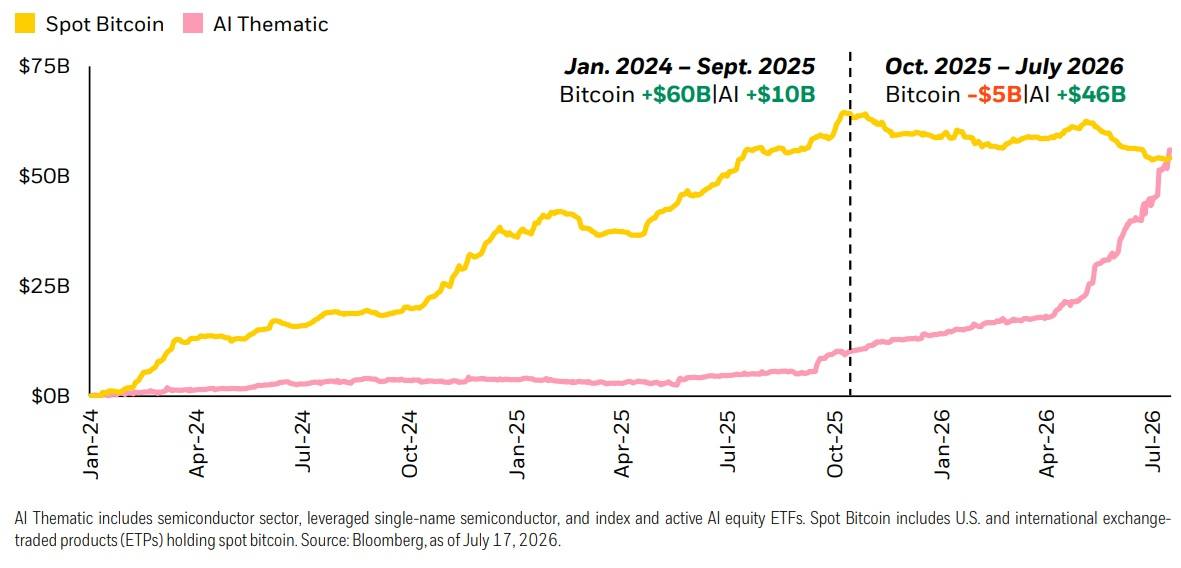
The firm also noted that artificial intelligence (AI)-themed funds pulled in more than $46 billion in the months after October, a rotation of institutional capital toward a competing narrative that likely compounded bitcoin’s underperformance even as its core case stayed unchanged in Blackrock’s view.
Where the Selling Pressure Came From
U.S. spot bitcoin ETPs saw roughly $5 billion in aggregate outflows during the drawdown, a meaningful reversal after the products drove much of the asset’s 2024 and 2025 rally. Strategy, the bitcoin treasury company formerly known as Microstrategy, sold a small amount of its bitcoin holdings in June and introduced a new capital-allocation framework that explicitly permits further sales under certain conditions, a shift for a company that had built its identity around never selling.
Blackrock’s own iShares Bitcoin Trust, the ETF known by its IBIT ticker, was also party to a $1.3 billion block trade during the period, signalling how concentrated large institutional flows have become even as retail participation cooled. Despite that pressure, Blackrock’s flagship fund has continued attracting fresh capital on stronger days.
Bitcoin.com News recently tracked IBIT pulling in $479 million as bitcoin exchange-traded funds (ETFs) extended an inflow streak, and a separate session in which Blackrock’s $50.2 million inflow helped offset selling elsewhere in the ETF complex. The data seems to be indicative of the fact that institutional demand hasn’t disappeared so much as become more selective about timing entries during the downturn.
Bitcoin’s “Dual Personality”
Another aspect covered in the report has been bitcoin and its “dual personality” when it comes to institutional portfolios, i.e. at times the asset trades in step with risk assets like equities during broad deleveraging events, and at other times acting as a hedge during geopolitical shocks.
Blackrock characterized the periods when bitcoin correlates more closely with stocks as episodic rather than structural, meaning that it does not view the recent risk-on/risk-off trading pattern as a permanent shift in what bitcoin is for.
In any case, the financial behemoth has continued to recommend that a modest bitcoin allocation, in the range of 1% to 2% (funded by trimming equity exposure within a classic 60/40 stock-and-bond portfolio), remains part of investor portfolios.