




Most brands still pick influencers the way they pick billboards: by size. The bigger the following, the better the buy. But the data has pointed the other way for years, and nowhere is that clearer than at the bottom of the follower ladder. Global spend on influencer marketing reached $32.55 billion in 2025, and a growing share of it is flowing toward the smallest creators of all.
Those creators are nano influencers, and they post the highest engagement of any tier while costing the least to work with. If you run a local business, a niche product, or a budget that has to stretch, they are often the smartest place to start. I have spent a lot of time on this question. I wrote about nano influencers in the The Age of Influence way back in 2020, I teach influencer marketing at UCLA Extension, and I build creator programs as a Fractional CMO. The case for nano creators is not that they are a cheap version of a real influencer. For a lot of brands, they are the better partner. This guide covers what they are, why their numbers beat bigger names, when to choose them over micro or macro, and how to find and work with them.
Key Takeaways
✅ Nano influencers have 1,000 to 10,000 followers. They sit at the entry point of the five-tier influencer ladder, just below micro influencers.
✅ They post the highest engagement of any tier. Engagement falls as follower counts climb, which is why small creators outperform big names on a per-post basis.
✅ They are the majority of the creator pool. Most influencers on Instagram and TikTok are nano-sized, so this is where the depth of choice actually is.
✅ They win on trust, niche fit, and cost. Choose nano for local campaigns, niche products, authentic testimonials, and budgets that fund several partnerships at once.
✅ The biggest mistake is treating them like cheap macro influencers. Their value is the relationship with their audience, not polished production, so brief them differently.
What Is a Nano Influencer?
A nano influencer is a content creator with roughly 1,000 to 10,000 followers who holds real sway over a small, tightly connected audience. They sit at the entry point of the five-tier influencer ladder, below micro, mid-tier, macro, and mega creators. What sets them apart is not reach but closeness.
That 1,000 to 10,000 range is the cutoff used across the industry. The lower bound matters as much as the upper one. Below about 1,000 followers, most accounts have not built enough of an audience to move anyone. Once a creator crosses 1,000, they start showing the thing brands actually want: a group of people who pay attention to what they say.
These creators are also the bulk of the market, not a fringe of it. According to HypeAuditor’s State of Influencer Marketing 2025, which analyzed 76 million Instagram and 104 million TikTok accounts, 76% of Instagram influencers and 87% of TikTok influencers are nano-sized. When you picture the influencer economy, picture them. Mega-celebrities are the exception. Everyday creators with a few thousand engaged followers are the rule, and they make up most of the types of influencers a brand can actually reach.
Why Do Nano Influencers Get Such High Engagement?
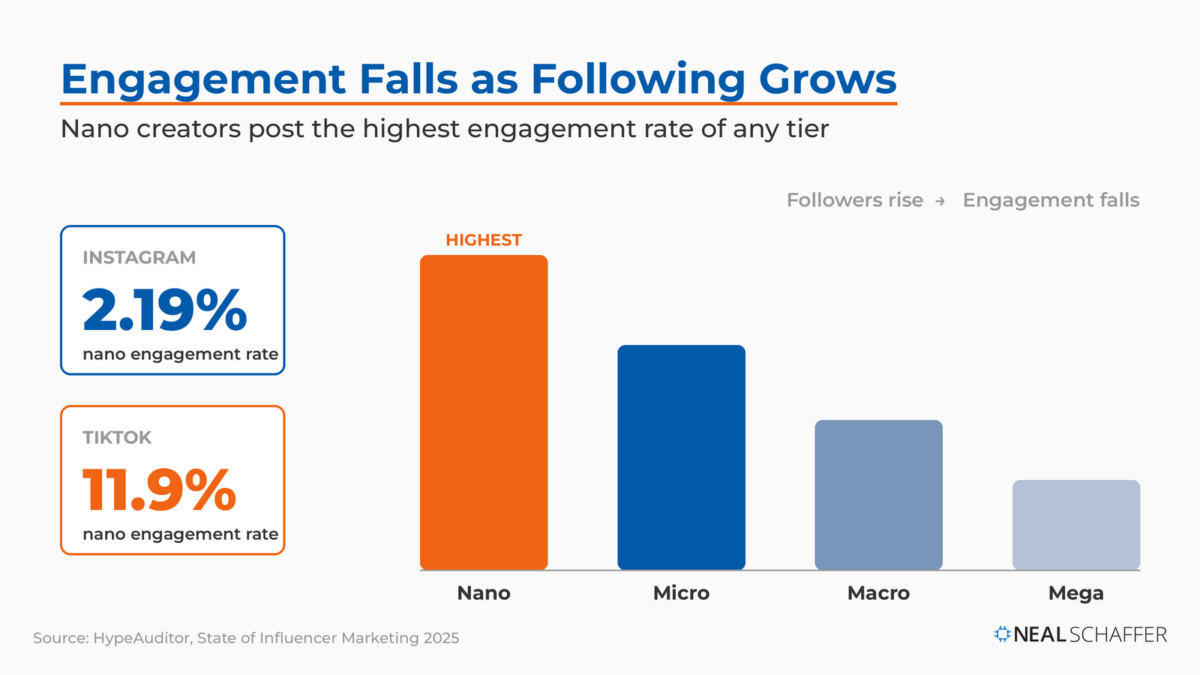
Nano influencers earn the highest engagement rate of any tier because their audiences are small enough to feel personal. A creator with 4,000 followers can answer comments, recognize regulars, and reply to DMs. That two-way attention builds trust, and trust is what turns a recommendation into a purchase. Engagement reliably falls as follower counts rise.
The numbers are not subtle. HypeAuditor’s analysis found that nano creators post the highest engagement rate of any tier, at 2.19% on Instagram and 11.9% on TikTok, with the rate dropping steadily as accounts get bigger. A mega influencer with a million followers might reach a stadium, but most of that stadium is half-listening. A nano creator reaches a dinner table where everyone is leaning in.
There is a trust mechanism underneath those percentages. People believe other people more than they believe brands. Nielsen’s long-running research has found that recommendations from people we know are the most trusted form of marketing there is, well ahead of any paid format, in its Global Trust in Advertising research. A nano influencer sits close to that personal category. Their followers are often actual friends, neighbors, and people who found them through a shared niche, so a product mention reads like advice instead of an ad.
This is the point I make to my students when I teach this. On a recent episode of my podcast Your Digital Marketing Coach, recorded from a class I teach at UCLA Extension, I told them to
“treat them [nano influencers] as influencer royalty, even if they don’t have a million followers, because there just aren’t that many people that are talking about that subject online.”
Only a tiny share of social media users create content at all. A nano creator who shows up consistently in a niche is already in that rare group, and the engagement data is what that consistency looks like in a spreadsheet. The full pattern is laid out in the influencer marketing statistics, where the engagement-versus-size gap is hard to miss.
When Should a Brand Choose Nano Influencers Over Micro or Macro?
Choose nano influencers when trust, niche relevance, and budget efficiency matter more than raw reach. They are the right call for local campaigns, niche products that need a credible voice, product seeding, and any program that would rather fund several real relationships than one big name. They are the wrong call when your only goal is mass awareness fast.
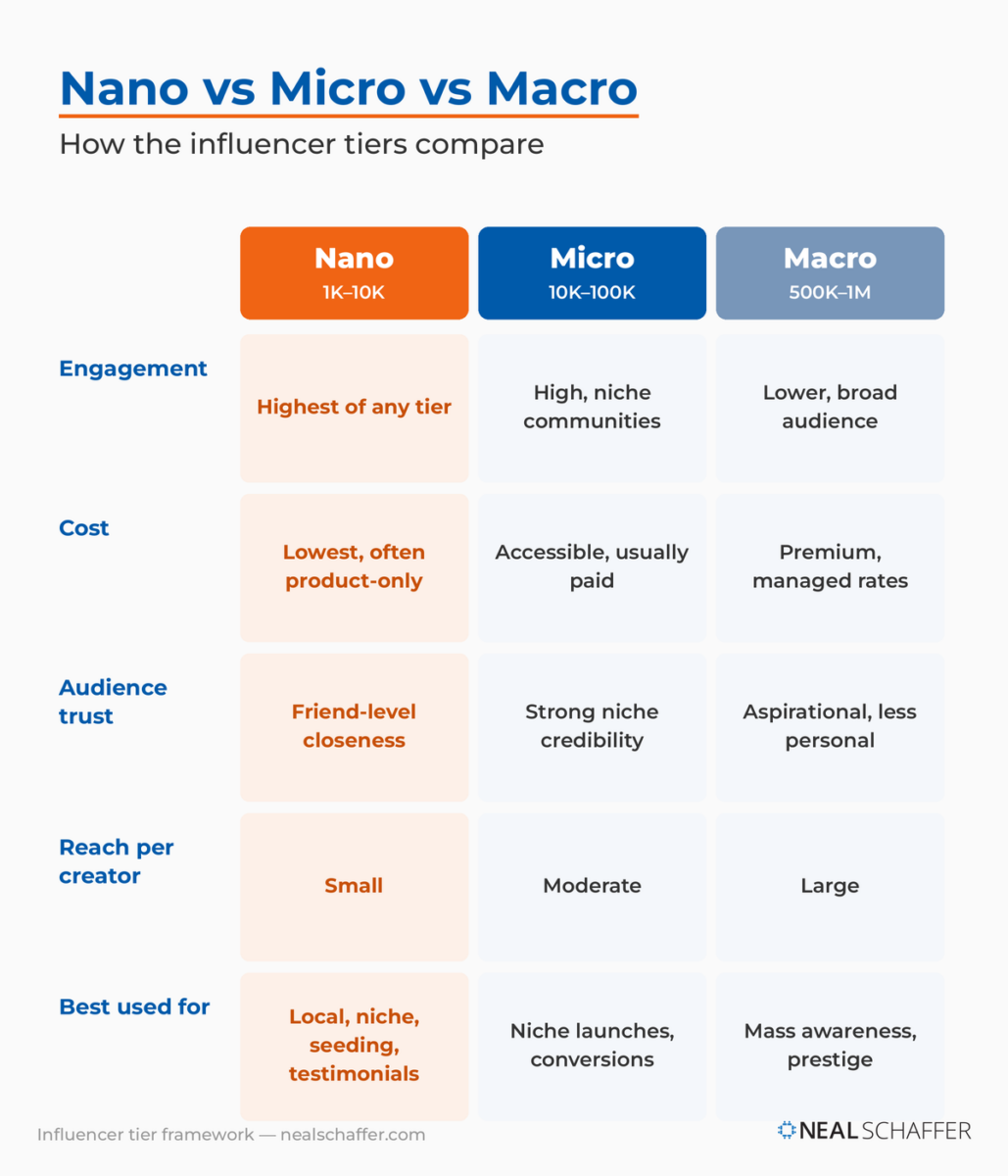
The trade-off comes down to reach versus resonance. A macro creator buys you a large audience and professional production, but at a lower engagement rate and a higher fee. A nano creator buys you a small, trusting audience at a fraction of the cost, with the catch that you usually need several of them to add up to real scale. Micro influencers, with 10,000 to 100,000 followers, sit in between. HubSpot’s research even named micro creators the top-performing tier, cited by 32% of marketers as delivering the most success, and nano is the tier feeding it from below.
| Factor | Nano (1K–10K) | Micro (10K–100K) | Macro (500K–1M) |
|---|---|---|---|
| Engagement | Highest of any tier | High, niche communities | Lower, broad audience |
| Cost | Lowest, often product-only | Accessible, usually paid | Premium, managed rates |
| Audience trust | Friend-level closeness | Strong niche credibility | Aspirational, less personal |
| Reach per creator | Small | Moderate | Large |
| Best used for | Local, niche, seeding, testimonials | Niche launches, conversions | Mass awareness, prestige |
This shift is already underway across the industry. Brands are shifting spend toward nano, micro, and mid-tier creators and away from macro and mega names, a trend eMarketer has tracked across the industry. The practical version is simple. A regional coffee roaster, a niche SaaS tool, or a beauty brand seeding a new product will almost always do better with nano creators dollar for dollar. A national campaign that needs millions of impressions in two weeks is where bigger tiers earn their fee. Most brands I work with are in the first situation far more often than the second. That is why I point them toward smaller creators first, inside the broader influencer marketing strategy that ties the tiers together. For the larger end, see how macro influencers and micro influencers compare.
What Most Brands Get Wrong About Nano Influencers
The most common mistake is treating nano influencers as a discount version of a macro deal. Brands send the same rigid brief, demand the same polished production, then wonder why the content feels stiff. A nano creator works because they sound like a real person, so a corporate script strips out the exact thing you are paying for.
A few other traps show up again and again. The first is chasing follower count inside the tier, picking the creator with 9,000 followers over the one with 3,000 when the smaller account has double the engagement and a tighter niche. Follower count is the vanity number. Engagement and fit are the real ones, and the creator economy statistics show how far reach and actual influence have drifted apart.
Another trap is ignoring your own backyard. Brands spend weeks hunting for strangers while their employees, customers, and email subscribers go untapped, even though some of those people are already nano influencers. Smaller followings have been a brand target for years now, ever since The New York Times flagged the rise of nano influencers back in 2018. The people closest to you are the most overlooked version of that opportunity.
The last trap is skipping verification. Fake and bot followers are the single biggest fraud problem in the industry, making up 56.5% of all reported issues, according to the Influencer Marketing Hub Benchmark Report 2026. A nano account is easier to vet than a big one because the engagement either looks human or it does not. Shopify lays out the telltale signs of fake followers, and a quick scan of who is commenting catches most of the problem before money changes hands.
How Do You Find the Right Nano Influencers?
Start with the people who already know your brand, then expand outward with simple platform searches. Your best nano influencers are often your own customers, employees, email subscribers, and engaged followers, because they already trust you and need no convincing to talk about you. Once that pool is mapped, free social search fills in the rest.
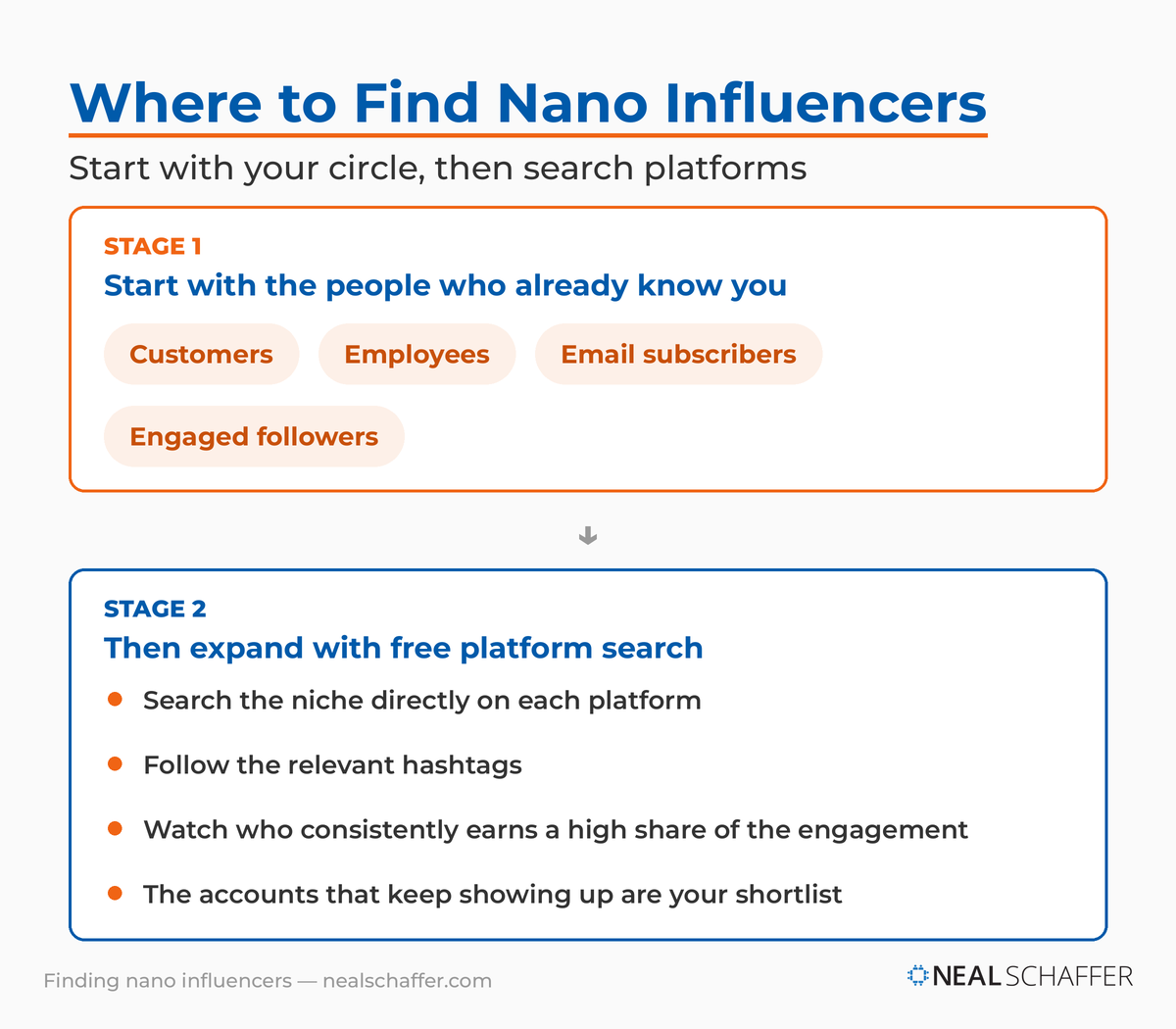
This is the core argument of The Age of Influence: your community is always a subset of your potential, and the first influencers to activate are the ones standing closest to you. Employees are especially underrated. When someone talks up the company they work for, friends and family listen, and that endorsement carries a weight no paid post can buy.
For everyone beyond your existing circle, you do not need an expensive tool to begin. Search the niche directly on each platform, follow the relevant hashtags, and watch who consistently earns a high share of the engagement on a topic. The accounts that keep showing up are your shortlist. The same approach works for finding influencers on any network. Once you are juggling more than a handful of names, a searchable influencer database keeps the roster from turning into spreadsheet chaos. If you sell to other businesses, the playbook for brands that work with micro influencers translates directly down a tier.
One Strategy to Connect All Your Marketing
My latest book helps small businesses, entrepreneurs, and marketers bring search, email, and social together into one digital marketing strategy that actually compounds.
Drawing on my work as a Fractional CMO, Digital Threads turns complicated tactics into a clear, practical plan you can follow, whatever your budget or team size.
Grab your copy on Amazon and start weaving your own digital threads. Click the cover or the button below to get started.

How Do You Work With Nano Influencers, and What Do They Cost?
Work with nano influencers through low-friction, high-trust arrangements: gifted product, affiliate or discount codes, sponsored giveaways, and ongoing brand-ambassador relationships. Many will partner for product alone, and market pricing sits lower than most brands expect, so a modest budget can fund several creators at once rather than one big name.
On cost, the reality is encouraging for smaller brands. Half of all influencers charge between $250 and $1,000 per post, and 71% offer discounts for longer-term partnerships, according to Sprout Social’s 2025 Influencer Marketing Report. Nano creators sit at the low end of that range, and many are happy to work for gifted product early on. I dug into how influencer gifting builds a business with Mike Baddeley on my podcast, and the throughline was that the gift is what makes authentic content possible in the first place. For the full picture of how influencers make money and how much an influencer makes by tier, I cover both separately.
| Model | How it works | Best for |
|---|---|---|
| Gifted product | Send product for an honest review | Specific, credible content with low cash outlay |
| Affiliate or discount codes | Creator earns on what they drive | Performance budgets and trackable results |
| Sponsored giveaway | Creator hosts a giveaway you fund | Fast audience exposure and follower growth |
| Brand ambassador | An ongoing role over months | Steady content and a loyal, repeatable partner |
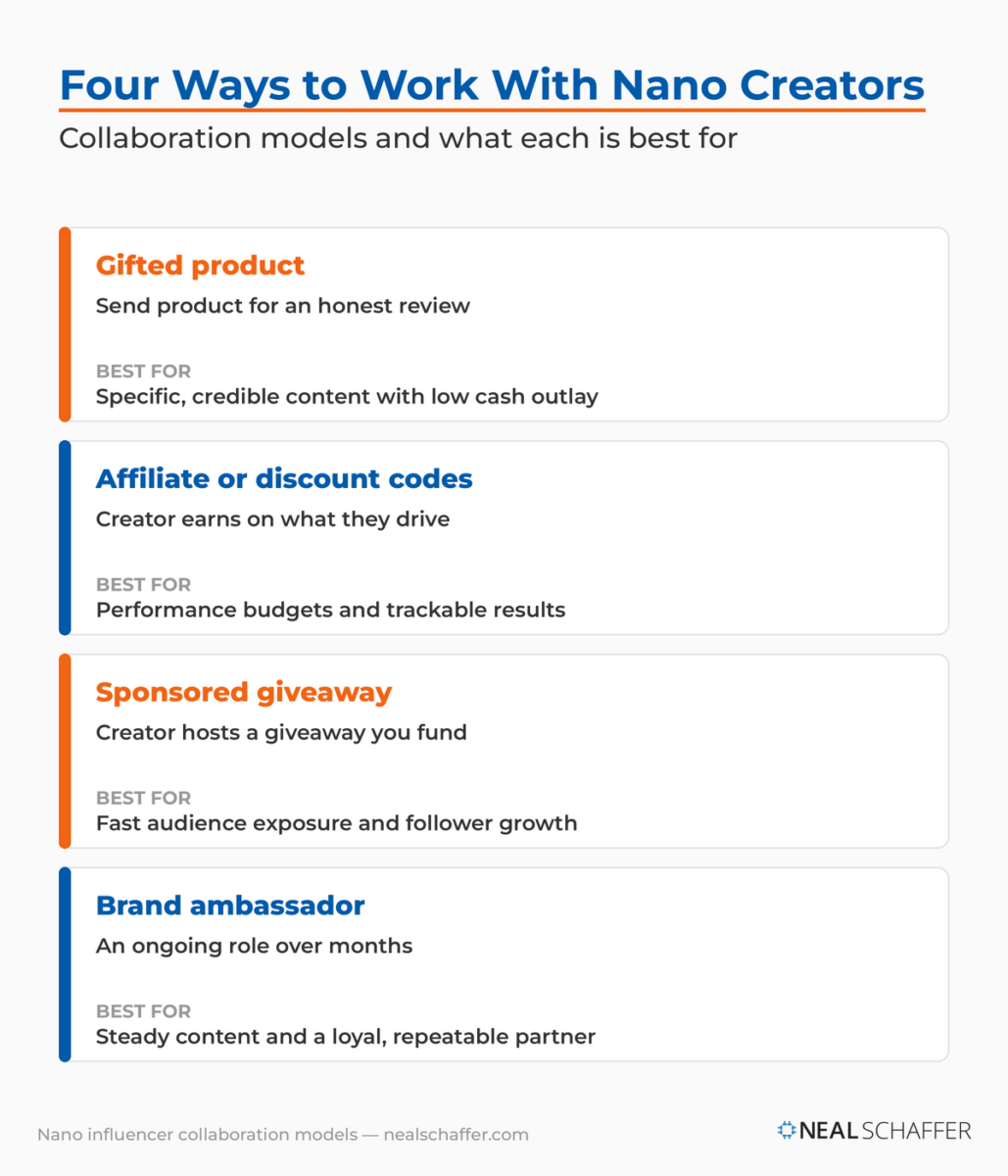
That last model is where nano creators shine. Because they have not been flooded with offers, an ongoing role is genuinely exciting to them, and their posts keep feeding your channels as repurposable content from a UGC creator. One rule applies to every model: disclosure is not optional. Any gifted or paid relationship has to be disclosed clearly. The FTC sets specific rules for how influencers do it, and I break those out in plain English in my take on the FTC influencer guidelines. Get disclosure right and the authenticity that makes nano creators valuable stays intact.
Frequently Asked Questions
A nano influencer is a content creator with roughly 1,000 to 10,000 followers who has built a small, highly engaged, trusting audience, usually around a specific niche. They sit at the entry level of the influencer tiers, just below micro influencers, and they make up the majority of creators on Instagram and TikTok.
Yes, often better than larger creators on a per-post basis. Nano influencers post the highest engagement rate of any tier, 2.19% on Instagram and 11.9% on TikTok, because their audiences trust them like a friend. That trust is what moves a follower from interest to purchase, even though the total audience is small.
Less than most brands expect. Across all tiers, half of influencers charge between $250 and $1,000 per post, and nano creators sit at the low end. Many will partner for gifted product alone, particularly for an honest review or an ongoing ambassador relationship.
For most small and local businesses, they are the best place to start. You can fund several nano partnerships for the price of one larger creator, and the content feels authentic. The audiences are often local or niche enough to match exactly who you are trying to reach.
Between about 1,000 and 10,000 followers. Below 1,000, an account usually has not built enough of an audience to influence purchasing. Above 10,000, a creator moves into the micro influencer tier, where reach grows but engagement typically starts to slip.
Start Small to Win Big With Nano Influencers
If you take one thing from this, make it the order of operations. Map the nano creators who already know you, vet them for real engagement, brief them as the authentic voices they are, and fund several relationships instead of one big name. That approach fits almost any real budget.
To see how nano creators stack up against every other tier before you commit, the full influencer tiers framework lays out the ladder from nano to mega. If you want a strategist to build the program with you, my Fractional CMO services are built for exactly this kind of work. And if you would rather start with the thinking behind it, grab a free preview of The Age of Influence. It shows how the strategy fits together before you spend a dollar on creators.
Actionable advice for your digital / content / influencer / social media marketing.
Join 13,000+ smart professionals who subscribe to my regular updates.