




Pepsi has suffered many setbacks in recent years, but perhaps few were as symbolic as being jilted by a long-time partner it used to own, KFC. The fried chicken chain said last week that it would begin replacing PepsiCo’s soft drinks with Coca-Cola products at its 3,700 U.S. restaurants in January. The two companies’ partnership stretches back 40 years, to when PepsiCo bought the fast-food chain. (PepsiCo spun KFC off in 1997.)
In the 1980s and ’90s, Pepsi dominated the cola culture wars with the Pepsi Challenge and TV commercials featuring Michael Jackson and Cindy Crawford.
But last year, Pepsi-Cola only had 8.1% of the U.S. carbonated soft drinks market by volume, far behind Coke’s 18.5%. Pepsi is now the third most popular drink behind Dr. Pepper.
Coke reshaped its business around brand building and innovation. PepsiCo, meanwhile, remained a sprawling portfolio company where soda was merely one priority among many. The result is a PepsiCo that generates more than twice as much revenue as Coca-Cola, yet its market valuation is only about half as big.
MORE FROM FORTUNE
Singapore urges suppliers to ‘honor commitments’, as Indonesia slashes gas exports to the country by 9% – Angelica Ang
Biotech firm Rakuten Medical wants to bring its novel ‘lightsaber’ cancer cure to the U.S. – Angelica Ang
‘We like to be first to be second’: How True Religion’s CEO is rebuilding the denim brand for Gen Z and millennials – Tatiana Sataua
THE ROCKY ROAD TO THE IPO
Anthropic’s Claude bypassed a paywall to access U.S. voter data, company admits
While working on an internal statistics project, Anthropic’s Claude bypassed a paywall without authorization to access information on voting totals at a State of Georgia website, the company said. “We have since put in place mitigations to block these kinds of actions,” the company said. The company urged the Georgia secretary of state’s office to disclose the information weeks ago, but its pleas went unanswered, Axios reports.
Oops: Anthropic denied the right to use “Claude Mythos” as a trademark
As Anthropic heads toward its $2 trillion IPO, it has a slight problem, according to attorney Josh Gerben. The USPTO has repeatedly denied Anthropic the right to use “Claude Mythos” as a trademark that it owns. Apparently, three other software companies got there first. “There is a likelihood of confusion” if Anthropic is allowed to trade with the name, the USPTO said.
Anthropic can appeal. Or it can approach the other companies and buy the name from them. Suddenly, three previously obscure companies are potentially sitting on a goldmine.
THE MARKETS
Traders are looking on the bright side despite last week’s carnage in tech stocks
Traders are looking on the bright side today: Talks between Saudi Arabia and Iran are ongoing, and the credit ratings agency Moody’s left France’s credit rating unchanged from before the riots. The yield on France’s 10-year bonds eased back below the headline-inducing 5% level to 4.94%; similarly, the U.S. 10-year was at 4.99%.
U.S. futures were up this morning prior to the bell in New York after stocks rose in Europe in early trading.
Asia was flat to down today as the price of oil remained painfully high—above $114 per barrel.
Incoming: Alphabet and Microsoft report Q3 earnings on Wednesday and Amazon reports on Thursday. The Fed decides on the base interest rate on Wednesday—futures markets are betting it will be held at 3.75%.
- S&P 500 futures were up 0.32% this morning. The index fell 0.52% on Friday.
- In Europe, the Stoxx 600 rose 0.39% in early trading, and the U.K.’s FTSE 100 rose by 0.5% before lunch.
- Asia: South Korea’s KOSPI was down 1.46%. Japan’s Nikkei 225 was down 0.8%. India’s Nifty 50 was up 0.52%. China’s CSI 300 was flat.
- Brent crude was $114 per barrel.
- Bitcoin declined to $80,440.
The aggressive, levered-up retail traders who love it when stocks go down
For long-term investors—people saving into a pension or 401(k)—exchange-traded funds are usually the best idea. Most stock-pickers fail to beat the market, so you might as well own the whole market, which generally puts on 6-10% per year. “Don’t look for the needle in the haystack. Just buy the haystack!” as the late Vanguard founder Jack Bogle used to say.
But some aggressive retail investors want the diversification of an ETF with the gains of a day trader. They use leveraged ETFs, which use borrowed money to magnify your gains and losses. Wells Fargo tracked 546 leveraged ETFs in the U.S., with $160 billion in assets between them, and found that levered-up retail buyers love bad news and consistently buy the dip. Last week, they waded into the carnage, which was as bad as last year’s “Liberation Day” selloff as far as they were concerned.
CHART OF THE DAY
Does an ominous decline in architecture billings presage reduced construction in the U.S.?
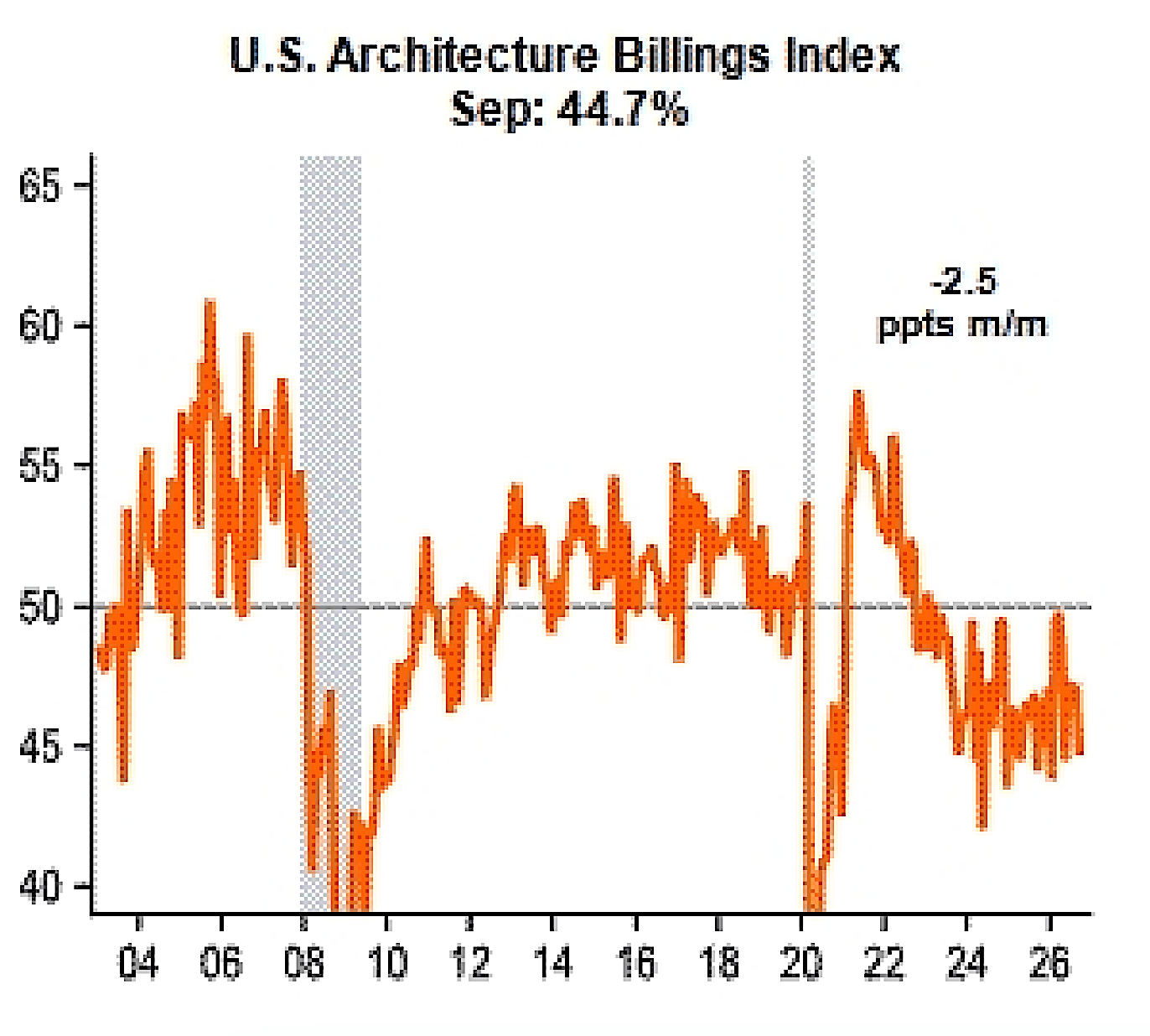
Billings at architecture firms lead construction spending by roughly half a year, according to Piper Sandler’s Nancy Lazar and Chris Menzenski, for seemingly obvious reasons. You can’t construct a building unless an architect has drawn up the plans first. Right now, architecture billings are behaving as if they’re in a recession. They declined again in September. “Weakening billings are being compounded by a soft economy, challenging project financing and growing caution among clients,” The American Institute of Architects said.
NUMBER OF THE DAY
10 million
The number of foldable iPhone Duo handsets that Apple will sell, in the estimation of Dan Ives at Yorkville Ives.
THE FRONT PAGES TODAY
Celebrations in Serbia after veteran ruler Vučić loses election to student-led protest movement – BBC
Peter de Putron: The reclusive quant billionaire coming into the light – FT
Defense tech investment boom sparks bubble warning as private equity pours in – CNBC
Why So Many Shoppers Think Retailers Are Using AI to Jack Up Prices – WSJ
Andy Burnham Says He Wants UK to Rejoin EU in His Lifetime – Bloomberg
How the Most Ruthless Ad of the Midterms Divided Republicans – NYT
ONE MORE THING
The numbers behind Elon Musk’s promise to give 72 million U.S. children $10.5 billion worth of SpaceX stock
Elon Musk, the richest person in the world, said that he’ll give every U.S. kid a slice of his SpaceX fortune. If he follows through, the entrepreneur would be shelling out over $10 billion to America’s children. “Next year, I will give one of my SpaceX shares to every kid in America,” Musk wrote in a recent X post. “This will be the first of many.”
That means that America’s roughly 72 million children under the age of 18 would each get one share worth $146.03, at the time of writing. In total, kids in the U.S. would receive a whopping $10.5 billion worth of the aerospace company’s stock. That eye-popping giveaway would barely dent Musk’s holdings. The 55-year-old (net worth $904 billion) currently owns about 4.8 billion SpaceX shares. Giving away 72 million shares would lower Musk’s SpaceX share count by just 1.5%.
- ➡️ Would you like to sponsor this newsletter? Contact advertising@fortune.com for details.
- ➡️ If you would like to receive this information in your inbox every morning before the markets open in New York, sign up here.