




Since its inception in 1990, the Human Genome Project has led to breakthroughs in our understanding of genetics. In April 2003, the project was declared complete after scientists determined the sequence of the 3 billion chemical base pairs that make up human DNA. Alas, many questions remain about the physical rules governing a genome’s organization. Among them is the question of how gravity influences life on Earth, right down to the mitochondrial level.
A new study led by researchers at the Center for Soft Matter Research at New York University (NYU) seeks to address this question to help mitigate the effects of spaceflight. Behind their work is an innovative technique for creating a microgravity environment to reveal gravity’s impact on human cells. This research has two goals: to isolate gravity’s impact on human genes and to show how the genome functions in zero gravity.
Thanks to decades of expeditions to the International Space Station (ISS), scientists have learned that prolonged time in space can significantly affect human physiology. These include muscle atrophy, bone density loss, vision problems, and effects on the cardiovascular and central nervous systems. NASA’s famous Twins Study also revealed that microgravity affects astronauts on the genetic level. The full extent of these effects is not yet known, raising the need for more research.
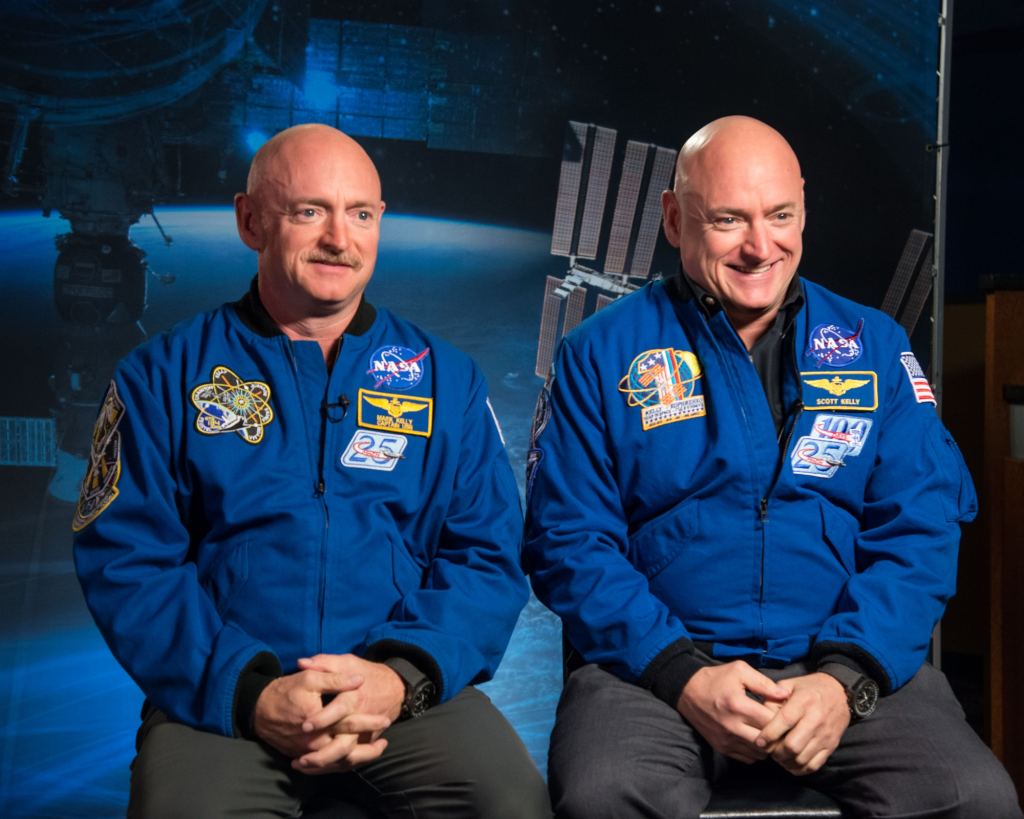
Identical twin astronauts, Scott and Mark Kelly, are subjects of NASA’s Twins Study. Scott (right) spent a year in space while Mark (left) stayed on Earth as a control subject. Researchers looked at the effects of space travel on the human body. Credit: NASA
Despite the significance of the human genome, we still don’t fully understand the physical principles governing its organization. What is known is that its structure is highly complex, consisting of a one-dimensional sequence encoded in two meters of DNA molecules packed inside a tiny cell nucleus barely 10 micrometers in size. It is also known that its structure is directly related to its function, and deviations can lead to diseases like cancer and developmental disabilities.
As Alexandra Zidovska, an associate professor in New York University’s Department of Physics, explained:
On Earth, the role of gravity is intriguing—it is a constant mechanical stress on everything. We wanted to know what gravity’s role is in the genome’s organization and function here on Earth. To uncover it, you have to remove gravity as a force, so we simulated zero gravity in our experiments. Beyond Earth, the question of lack of gravity is also compelling: How will the human genome be affected when in outer space? We think our findings can be useful in better understanding how space travel affects us.
For their experiment, the NYU researchers designed and built a Random Positioning Machine (RPM) similar to the ones astronauts use for training. The machine was paired with dishes of living cell cultures, which were rotated along two different axes, following a three-dimensional path. This allowed the team to image the genes within the cell cultures and note how they responded to microgravity.
The researchers also developed 3D algorithms to simulate microgravity and minimize fluid flow, which typically arises during 3D rotation experiments on Earth but is absent in microgravity. They also developed algorithms to investigate how these flows would affect the cells. These innovations led to a reduction in both flows and the formation of cell aggregates, which obscured the effects of microgravity in previous studies.
After 24 hours of exposure to simulated microgravity or fluid flows, the scientists used advanced imaging techniques to observe the cells under each condition. They then recorded streams of images to conduct a detailed analysis, noting changes in the cells and their nuclei, as well as changes in the genome’s organization, dynamics, and possible DNA damage induced by simulated microgravity.
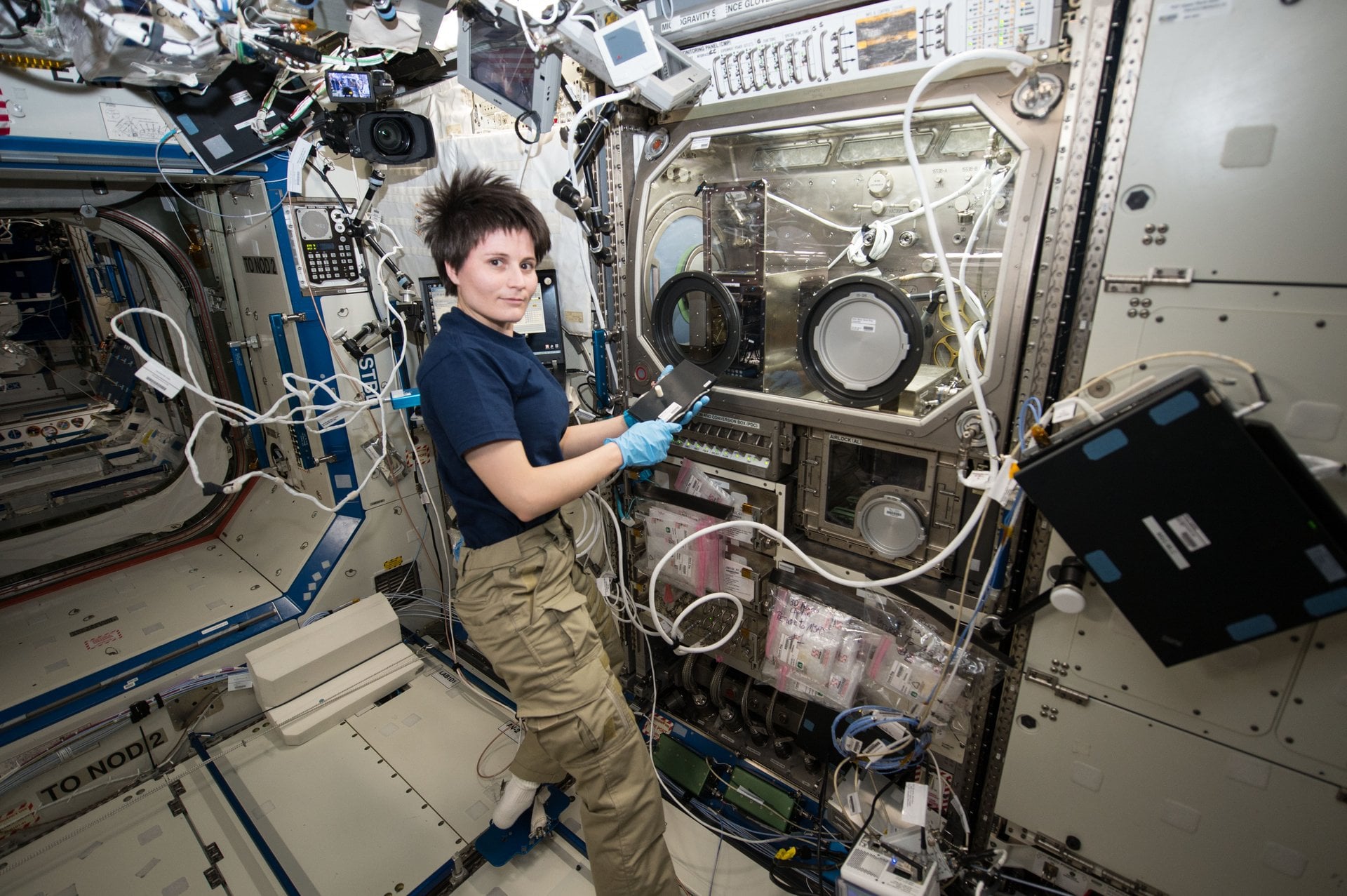 European Space Agency astronaut Samantha Cristoforetti works with the Microgravity Science Glovebox aboard the International Space Station in 2014. Credits: NASA
Overall, the results showed that microgravity increases the volume of the cell nucleus, indicating that gravity diminishes it. They also indicated that exposure to flows elongated the cells. Despite these changes, the thickness and structure of the cells’ nuclear envelope remained unchanged, suggesting gravity has minimal impact on these traits. The genome inside the cell nucleus maintained its physical organization and motions after 24-hour exposure.
Overall, the team found that a day-long exposure to simulated microgravity led to rather subtle changes, but note that these could amplify over time. The researchers also showed that microgravity does not cause DNA damage, but damage did occur when the cells were exposed to flows. Said Zidovska:
Our data show that the genome, its organization, and dynamics are incredibly robust and seem unaffected by gravity, or lack thereof, after 24 hours. Similarly, these results suggest that the physical organization of the human genome may change little in outer space over comparable timeframes. However, such changes could occur during longer exposures and due to DNA damage occurring in space.
This study offers fundamental insights into genome organization and highlights gravity’s role in regulating life on Earth. The results are encouraging, showing that our genome is highly robust against mechanical stress and could withstand exposure to microgravity without serious changes. Nevertheless, this experiment is the tip of the iceberg when it comes to researching the long-term effects of microgravity. Understanding the range of effects is essential for future long-duration missions to places like the Moon, Mars, and beyond.
The paper describing the researchers’ findings was published in Science Advances.
Further Reading: New York University, Science Advances