




Every time Sophie Okonedo appears on screen, she shifts the tenor of the movie she’s in. Her work is always a form of elevated disruption, where the film’s subtext and unspoken emotional tenor crystallize in her piercing gaze, warm eyes, and striking figure. She would be the first to tell you that her intentionality of performance and the groundedness with which she carries her body are qualities she brings to all her parts, no matter how big or small.
She has two performances this year, from two different directing duos, in the films “Clarissa,” from brothers Chuko and Arie Esiri, and “Mouse,” from Kelly O’Sullivan and Alex Thompson, which feels like a cumulative pronouncement of what has made her past work so striking. At the same time, she charts a bold new chapter of earthy, subdued, and vibrant performances in her career.
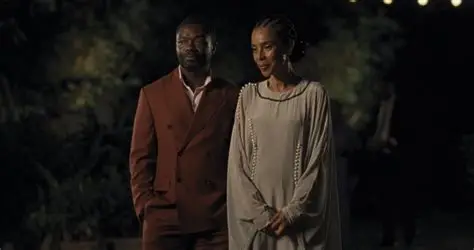
That both projects, despite being so different formally and geographically (it’s hard to think of a place farther away from Lagos than Arkansas), yet feel similar in their themes, is also thanks to the way Okonedo wears the long, unspoken histories of both characters on their faces. In Esiri’s film, she plays Clarissa, a woman of nobility who is organizing a party for many of her old friends, flames, and family.
In the throes of her preparation, she reflects on the road to her present circumstances, as the film oscillates between Okonedo’s wise, weary performance and India Amarteifio, who plays a younger version of her. Clarissa is a character we see come alive again throughout the film, the bones of her latent dreams and buried hopes resurrecting in the moments she allows herself to dance and be merry.
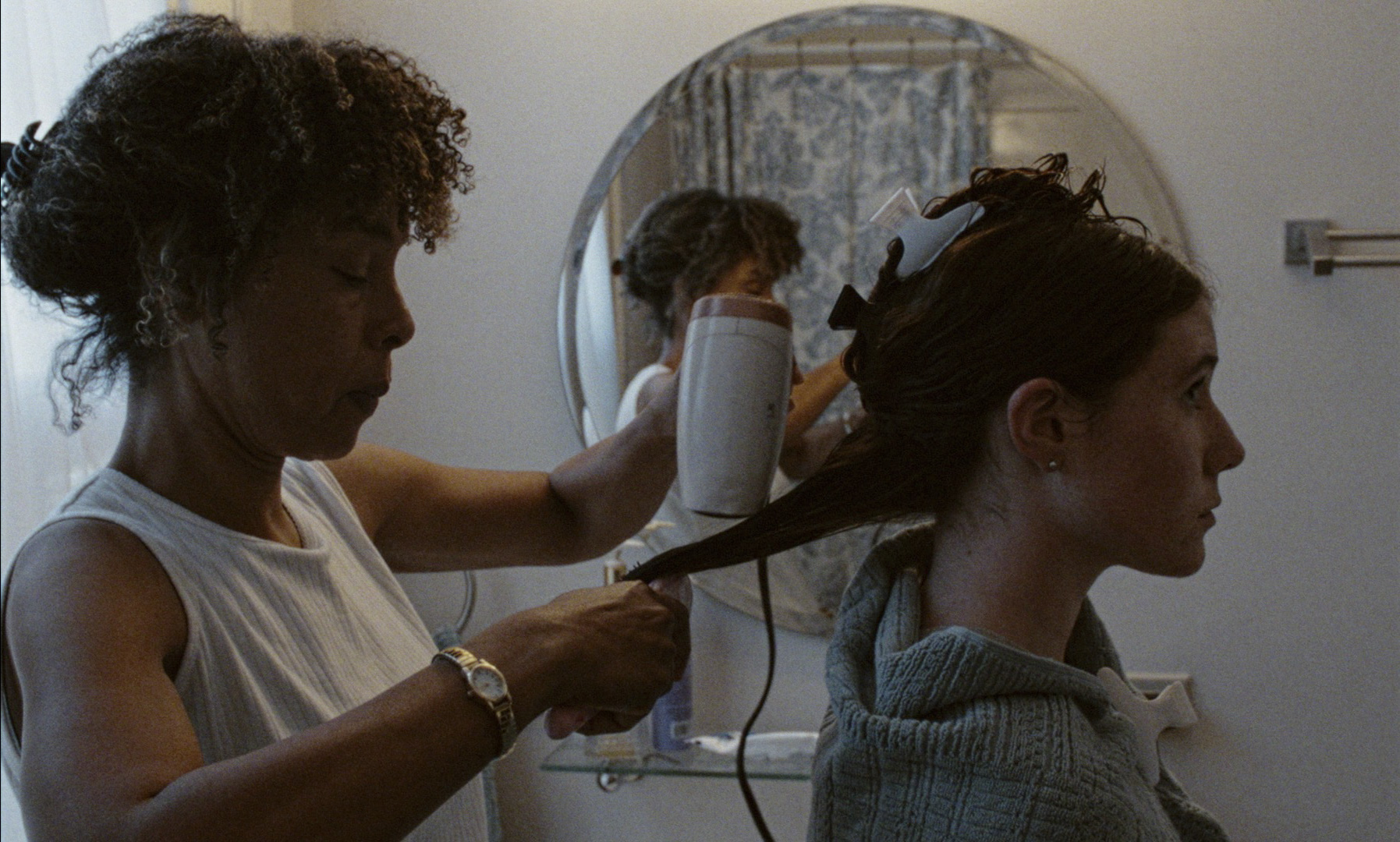
A different kind of resurrection is also present in “Mouse,” although Okonedo’s Helen is a character best defined by her aching grief. She loses her daughter at the start of the film, while forming an intense bond with her daughter’s friend, Minnie (Katherine Mallen Kupferer), who reveals a side of Helen that she did not have access to.
Okonedo understands that the type of pain that Helen experiences does not manifest in vociferous ways; it is in the piercing glances one gives when looking at “long-lasting candles” in the grocery store or the quick escape one takes when a well-meaning but ignorant co-worker suggests adoption as an option to salve grief.
“Clarissa” and “Mouse” are films about regrets, about lives lived, about the lives that could have been lived, about how the choices we least expect or do not give much thought to come to define us most significantly. For Okonedo, as she rightfully and cautiously affords herself the deserved encomium of dual roles, she remains consistently humble and curious. “I never feel like I arrived. I always feel like I’m learning and I feel like it’s hard to crystallize what I do,” she admits.
While Okonedo was in town to receive the film’s Spotlight Award, she tried her best to crystallize some element of the film’s art. RogerEbert.com spoke with her in person about the visual, thematic, and spiritual synergy between her two roles, experiencing homecomings in going to Lagos (and, in turn, being part of O’Sullivan’s homecoming), and calibrating micro-movements to communicate depth of emotion.
This interview has been edited for length and clarity.
I’m trying to think of the last time you had to promote two projects around the same time, and it was with “Wild Rose” and “Hellboy.”
Sophie Okonedo: Well, I was also doing Anthony and Cleopatra when those movies were coming out. I didn’t have major parts in those films, but with “Clarissa” and “Mouse,” these roles are much more substantial. With these roles, it feels like I’m doing what I really want to do, playing parts I really want to play. They were filmed a year apart, so it is a coincidence that they’re coming out at the same time. They are both indie movies that can easily get lost.
What I find serendipitous about this moment is that you not only have these two intimate character studies, but you are working with two pairs of co-directors.
What is powerful about both is that in both sets, one of the directors–Chuko for “Clarissa” and Kelly for “Mouse”–wrote the script. These are top-level writers who direct and work with their brother or husband. I’m script-based, so I’malways going about the story, what it is, what stories make up the characters, and such. I was led to both of these projects not only because of the wonderful stories, but also because of the arc of the particular character I was playing. I loved playing complex, unusual human characters that have multiple things going on at the same time. It’s a fun challenge to play characters with so much going on.
You’ve spoken before about how you’re often asking writers to take dialogue out of your scenes. With “Clarissa,” you don’t have many speaking lines, and even in “Mouse,” so much of what makes Helen work is in those beats of silence. Did you find yourself drawing on similar skills when embodying them both? What did one demand of you that the other did not, and vice versa?
I have an expressive face, and in a lot of my roles, I’ve had to say a lot without saying anything. I’m always doing this kind of work where I use silence to my advantage, but whether it gets captured is another thing. You have to have the roles, and even when you get the roles, the camera may not be on you because you are not the lead or for another reason. You can be working away in the background, but it’s looking elsewhere. In that respect, it is easier to play the lead, but harder to play a small part, because the relief of playing a lead is that everything of yours can be captured. What’s challenging is playing minor roles and trying to create something out of them.
With both of these films, I did what I’ve always done, but Chuko, Aire, Alex, and Kelly have given me the chance for it to be seen. I’ve been working the way I have for many years, but it has taken a couple of sets of young directors to put me in front of their lens and go, “We want to watch what you do. We know you can do it. We now just want to watch you do it.”
You shared that when you and the older counterparts for “Clarissa” first got to Lagos, you did a table read where you and the older actors read the younger parts. Can you speak more to that read: what did it mean to play an older Clarissa while reading and performing what India ultimately ended up performing?
Yes, the younger versions of us had not all been cast yet, so we oldies thought, “Let’s just read the whole script because we’ll never get this opportunity again.” That was when I got the power of the story; I understood the power of looking back. If I did a stage adaptation, I would have probably tried to play both. That’s the magic of theater.
It was nice to start our filming experience with something I would do in a theater, to quite literally swing between different versions of myself. I really felt the reward of this when David Oyelowo and I rehearsed the breakup sequence our younger counterparts were set to do. It was heartbreaking; we were in tears. So when our characters reunite in the film, it helped that we had the beautiful, tragic memory of saying the words of rejection because we could tangibly understand what we had lost.
Rehearsals are a tricky thing because you have to know how to rehearse. Not all theater directors work like this, but some will improvise around moments you talk about in the play. I remember one moment where, in a given scene, a character says, “Do you remember the day we got married?”
The director stopped the rehearsal and had all of us improvise and create a wedding scene, freestyle a bit, and play different characters, then go back to filming the play as is. Then, for the entirety of the play’s run, I’ll be thinking of that wedding, and I can draw from it and improvise something in the moment based on a scene that doesn’t end up in the final film. Nothing is wasted, and rehearsals like that help ground the improvisation in something specific.
What were the rehearsals in “Mouse” like, especially since you are working with people like Tara Mallen who share a similar theater background?
I remember reading through the script, but because, as you said, Tara and Katherine Mallen Kupferer are theater people, a lot of rehearsal time wonderfully transitions into asking questions. It’s less “here’s how I’m going to say this line,” but more “What is Helen’s emotional state in this scene? How did something someone said a few beats ago manifest right now?” Sometimes for myself, I hardly ever say a scene out loud until a director says “action.”
What I cherish about both experiences is that because they were so close together, they became examples of building and sustaining chemistry. For “Clarissa,” I’ve known David, Nikki, Jude, and Danny for years. Just because you know each other does not mean you have chemistry. The beauty of Chuko and Arie’s script is that it made us all say, “This is true … what we’re going through feels true to me,” and we were able to meet each other in that truth.
That’s all chemistry really is, isn’t it? It is about the same truth that you recognize in yourself vibrating in the frame of another. Contrast this with “Mouse,” where I didn’t know my collaborators for as long, but we still formed camaraderie.
I’ve heard Chuko’s script is quite literary. I believe it is only eighty pages, but the film itself is one hundred and twenty minutes, which speaks to what you are saying about letting scenes breathe.
The way Chuko writes scene descriptions is extraordinary. It has a rhythm. Sometimes, when you read the mise en scene for crappy movies, you can think, “My brain is dead, and I’m drifting off,” because they are describing everything that should really be in the story but isn’t. They are trying to make you feel something when you’re reading it that’s not actually there inherently.
There are lots of jobs I do where they don’t withstand deep thinking because it’s just not there in the writing. So I have to take a slightly different approach with material. It is no diss to those roles. With “Mouse” and“Clarissa,” I have been thinking about the type of material that rewards deep interiority, stories that do not disintegrate when you think deeply about them but become, in a way, more joyous.
Your work always has a way of coming back. When I think of Helen and Clarissa, I see people looking for vessels to place their pain. Then, to comment on your work as a whole, I think of the film you did with Tom Harper, “War Book,” and how pertinent that feels in light of renewed anxiety around atomic warfare.
I’m happy you mentioned that film; Tom and Jack Thorne are still my friends, and we’re working on something now. I don’t think intellectually about why I choose certain jobs, but I do get an instant feeling about things and honor what my body tells me when I read something. When I choose projects, perhaps selfishly, I’m hoping it helps me make sense of the world we live in. That’s what stories do; they help me feel less alone as I try to understand. It’s weird how I often choose things that, on some level, have something to do with what’s going on with me right then.
With “Clarissa,” I had just finished doing a play, “A Month in the Country,” and both of them are looking back at one’s life and asking those questions we may be afraid to hear the answers to: “Have you married the right person?” and so forth. What I’ve found is that I often do a play, and that leans into the next part.
You filmed “Mouse” first, and for Kelly, that was a homecoming for her because you filmed in Arkansas. Then, in 2025, you filmed “Clarissa,” which you have described as your homecoming. Tell me about experiencing these returns to home.
What I had been doing before I did “Mouse” was Medea, and in that, she kills her children. I found that to be one of the most exhausting parts I’ve ever played. I did ten weeks of playing eight shows a week, and I do not think Greek plays are meant to be done for that long.
You had to become quite close to infanticide.
I got to do the grief bit in “Mouse,” the bit I couldn’t do on stage with Medea, because that character is the perpetrator and is cutting away a part of herself. That was an emotional year with those parts. It was quite a bit before I did “Clarissa” because I was waiting for it to enter production. I just learned to wait if you can afford to.
That was a lesson “Clarissa” taught me even before the cameras rolled. If you can financially afford to, wait for the parts that really speak to you. My craft is so precious to me, and I want to wait for the right things, and I don’t want to waste time. I also love being at home, seeing my family, and being with my friends, so waiting isn’t agony for me. There are so many interesting things happening in this crazy world because we’ve got so much to talk about. There’s so much to talk about in the world we live in now, but I want to talk about it through the lens of the great filmmakers.
I read that two days before you went to Lagos, you walked the path Mrs. Dalloway took through London in the novel. Obviously, Lagos is quite different, but I’m wondering if you can bring yourself back to that moment, what you learned from that time, and how that prepared you for your work in “Clarissa?”
Sometimes, when you do an adaptation, reading the source material isn’t always that helpful. Sometimes the writers take it in a way that is wildly different from the source material and then, rather than being present, you think, “Why are these writers doing something different from what I expected?” When I read the book, I didn’t get it, but then in my fifties it resonated. She makes lifetimes appear in the breadth of a sentence.
I do not live in London; I live in Sussex, Virginia Wolffe country. As I did my walk in London, I wrote a line down in the script and kept it in my mind as I walked: “She felt very young and remarkably aged. She sliced like a knife through everything and at the same time was outside looking on.”
Whenever I might have lost sense of who she was, I kept coming back to that line, that duality, that she is two things at once. She’s young and aged, and looking at London, it is a city with those same contradictions. It made me feel more connected not just to the character, but to the physical place this character originated from in Virginia’s mind.
Has working on these films made you think about the way you process grief, or the ways human beings create rituals, as honest and as arbitrary as they are, to contend with prickly emotions?
I’ve thought a lot about Federico García Lorca’s plays, and the grieving that goes on, how the wailing is a part of the grief, and how other cultures are so welcoming of that release. We have stepped out of that. At my age, I have friends who have gone. I think what I love about “Mouse,” in particular, is the way these characters help each other in their grief, even though they do it in different ways. Minnie and Helen, they’re the most unlikely couple, aren’t they? You’renot expecting those two at the beginning of the thing to get together … you’re not expecting that to be the movie.
What also unites these movies is the exploration of how class impacts the romantic and platonic relationships you’re able to form with others. It is a bit more pronounced with “Clarissa.”
What was liberating about “Clarissa” is that you do not see upper-class Nigerians represented much on screen. I remember a few years back, as I was discussing the film with Chuko and Arie, thinking, “What accent will my character have?” The two of them, with their thick British accents, said: “Well, you’ll sound just like us.”
I think other actors thought they would have to do a Nigerian dialect, whatever that is. David, I know, questioned it because there’sthat instinct to placate a Western audience, but I remember Chuko at dinner saying, “If people don’t get it, it’s not my business. I’m making this for my friends and me.” The difference between me and David is that, because he’s also a director, he thinks about the audience. I do not consider that as much. This is probably why I have never directed because I don’t have that bird’s-eye view (laughs).
Mr. Murdaugh says, “Helen is mourning the future that Callie won’t have.” It made me think of that line about “Clarissa,” where she says, “We put our best futures behind us and settle.”
Both of those lines are such complicated and sensitive notions about grief, aren’t they? It makes me think about how lucky I am to be in these films, with filmmakers who have a deep sensitivity to what’s happening in the world without drumming any particular overt message down. Those films remind me of the fluidity of grief, how we experience sadness at a particular point in time, but it ripples back to the past and future.
“Mouse” is in select theaters via IFC. “Clarissa” is in select theaters on December 11, via NEON.