




In shallow seas near Australia, a familiar, trunked face emerges from billowing tufts of red algae. The fish it belongs to, though, is new to science.
The woolly, reddish fish is a variety of ghost pipefish, camouflaged fishes related to seahorses. The species — described for the first time May 10 in the Journal of Fish Biology — has a striking resemblance to Mr. Snuffleupagus, Big Bird’s shaggy, mammothlike friend on Sesame Street.
Ghost pipefishes (Solenostomus) are so named because their extreme camouflage and geometric silhouettes let the fishes disappear like apparitions into coral reefs. The long-snouted swimmers range from the Red Sea to the western Pacific Ocean, visually mimicking coral, algae and seagrass with spooky accuracy. While scuba diving in Papua New Guinea in 2003, David Harasti — a marine biologist at the Port Stephens Fisheries Institute in Anna Bay, Australia — encountered a coppery, hairy-looking ghost pipefish unlike any of the six previously known species.
A tiny fish named for a mammoth character
Ichthyologist Graham Short and marine biologist David Harasti studied new specimens of Solenostomus snuffleupagus alongside previously unidentified ones collected from far northern Queensland in 1993 by the Australian Museum. The find represents the first new description of a ghost pipefish species in over two decades.
Tap the arrows to see more pictures of the snouted species.

G. Short and D. Harasti/Journal of Fish Biology, 2026 Michael Workman, G. Short and D. Harasti/Journal of Fish Biology, 2026 
David Harasti, G. Short and D. Harasti/Journal of Fish Biology, 2026
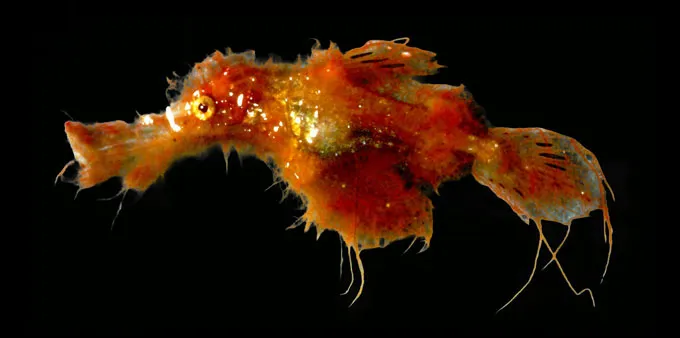
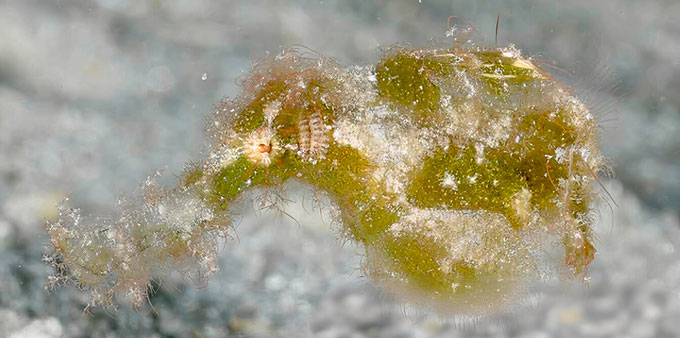
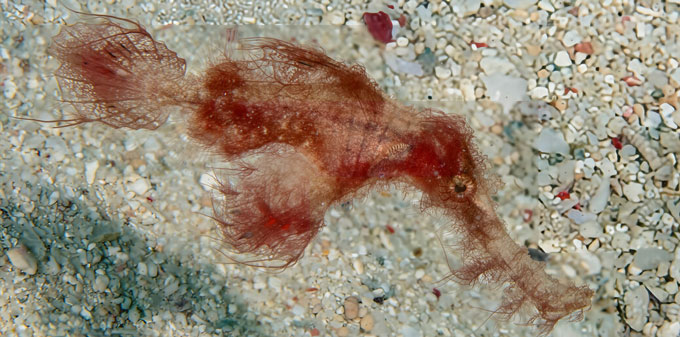

“He knew right away it was undescribed species,” says ichthyologist Graham Short of the Australian Museum Research Institute in Sydney.
Harasti returned to Papua New Guinea six times, Short says, but failed to find it again. In the mid-2000s, divers reported seeing the hairy ghost pipefish around the Great Barrier Reef. There, in 2022, Short and Harasti succeeded in collecting a male and female to bring back to the Australian Museum.
The fish — no longer than a matchstick — have evolved to move like floating algal debris, drifting passively back and forth, Short says. “They’re just stunning underwater … It’s just amazing that they’re actually fish.”
The hairy species is unique among ghost pipefish not only for its pelt of filaments, but it also has an extra vertebra and squatter shape. An evolutionary tree based on the fishes’ genes shows the fuzzy species split off from other ghost pipefishes early in their evolution, some 18 million years ago.
Short and Harasti named the fish Solenostomus snuffleupagus, since the pipefish’s hairy visage and long trunk reminded Harasti of the character from the classic children’s program. The fish ranges from Australia and Papua New Guinea eastward to Tonga.
The researchers say that discoveries like this show that even coral reefs that are exhaustively studied and sampled — such as the Great Barrier Reef — can still hold undescribed species. The duo’s next project: describing a ghost pipefish that closely mimics sponges.
Source link